Table of contents
Introduction
When I was a kid in Japan, summer meant boxes showing up at the house.
Not one box. Several of them, over about two weeks in July, stacked in the entryway until someone dealt with them.
The ones I wanted were the juice boxes.
Before you got to the juice, though, there was the box itself. Wrapped, and over the wrapping a sheet of white paper with brush writing down the middle of it.
I couldn't read it then. It just looked formal, like something you weren't supposed to tear into.
Then you got the lid off, and it was a flat cardboard tray of little cans, maybe twenty of them, every one a different color: peach, grape, mikan, apple, some melon thing. I'd look at it for a second before taking one.
I had no idea who sent them. My mother did, and she kept track, because a box arriving meant a box going back out.
That's ochūgen (お中元).
Mid-summer gifts, sent to the people you owe something to — a boss, a teacher, your in-laws, the doctor who took care of your family — as a way of saying thank you for this year, and please keep looking after us.
The part that catches people out is that there isn't one deadline. There are several, and which one applies to you depends entirely on where the person receiving the box lives.
Send to Tōkyō on the Ōsaka schedule, and you're a month late. Send to Ōsaka on the Tōkyō schedule, and you're early, which is less rude but still reads as slightly off.
This is the thoughtful part I love about Japan.
If you miss the period for sending gifts, you can change the wording on the label, and the same box becomes a shochū-mimai (暑中見舞い), meaning midsummer check-in, or a zansho-mimai (残暑見舞い), meaning late summer greeting.
The English-language guides mostly don't explain this.
Who you should not send to; that list is longer than people expect, and it includes teachers. And how to thank someone one time, properly, without accidentally signing yourself up to send them a box every July for the rest of your life.


Where Ochūgen (お中元) Came From
The chūgen part isn't Japanese in origin, and it has nothing to do with gifts.
In Daoism, there are three gen days, spaced through the lunar year: jōgen (上元) on the fifteenth of the first month, chūgen (中元) on the fifteenth of the seventh, and kagen (下元) on the fifteenth of the tenth. Each is the birthday of one of three deities.
The one attached to chūgen is the Earth Official, whose job is pardoning sins, so the day was kept as a day of atonement.
From what I've read, people spent it confessing what they'd done wrong, and then gave things to the people around them as part of making up for it. Which is already a gift custom, sort of. Just aimed at your own conscience rather than your boss.
The seventh month, fifteenth day also happened to be Urabon-e (盂蘭盆会) — the Buddhist ancestor memorial that became Obon.
Two observances landing on one date tend to merge, and these did. In Japan, what came out the other side was a summer where you set out offerings for the dead, and then shared those offerings around: rice, noodles, sweets, fruit, salted fish, carried between relatives and neighbors.
Some regions still don't call it ochūgen at all. They call it bonrei (盆礼) or bonku (盆供), which keeps the older meaning right there in the name.
And that's really the whole shift, in one line.
The same care you'd take putting food on the altar for your ancestors got pointed at the living instead — the client you've worked with for years, the teacher who looked after your kid, the doctor who took your calls.
Same gesture. Different recipient.
The step in between is the Edo period. Merchants settled their accounts twice a year, at Obon and at year's end.
When you went to square up with a customer, you brought something. That's a practical habit, not a religious one, and it spread from merchants and samurai households out to ordinary families.
By the Meiji era, the department stores had noticed and built a selling season around it. The ochūgen sale is over a century old.
The Same Day in China
One thing I hadn't realized until I went looking: the gift part is entirely Japanese.
China still keeps the seventh-month observance, but it stayed a day for the dead — offerings at the family altar, incense, paper money burned, lanterns floated on the water.
No boxes, no department store season, nobody sending juice to their section chief. That whole layer grew here and only here.
Two things follow from the history, and both matter later in this article.
The first is that ochūgen has a twin. If merchants settled up twice a year, there's a second gift season at the other settlement — that's oseibo (お歳暮), the year-end version: same logic, same recipients, colder weather. People generally treat them as a pair, and if you send one you're expected to send the other.
The second is the calendar. Japan switched from the lunar calendar to the solar one in 1873, and Obon didn't move cleanly. Some regions kept the date and observed it in July. Others shifted it a month later and kept observing in August. Nobody standardized it.
That single unresolved calendar change is why there is no such thing as the ochūgen deadline.

Timing by Region
There's no national deadline. There's a map.
| Region | Window |
| Kantō, Tōhoku | July 1 – July 15 |
| Hokuriku / Hokushin'etsu | Split. Cities like Kanazawa follow July 1 – 15; Japan Sea–side areas follow July 15 – August 15 |
| Hokkaidō | July 15 – August 15 |
| Tōkai, Kansai, Chūgoku, Shikoku | July 15 – August 15 |
| Kyūshū | August 1 – August 15 |
| Okinawa | Lunar July 15, so the date moves every year — check the current year's calendar. |
Kantō and Tōhoku switched to the new calendar after the Meiji reform and observe Obon in July. Most of the rest of the country kept it a month later.
Kyūshū is the outlier at the far end, with a window of about two weeks that runs straight into Obon itself.
Between Tōhoku and Kyūshū there's a full month of difference, which is a lot of room to get it wrong.
Okinawa is its own case. It still goes by the lunar calendar, so there's no fixed date to memorize — it lands somewhere in August most years, sometimes late August.
You have to look it up each time.
The safe zone. If you don't know where the recipient is, or you don't want to think about it: arrive between July 1 and July 15.
That's early for the western regions, but nobody treats early as rude.
Late is the problem, not early.
Everything is drifting earlier. The department stores open ochūgen ordering in June, run early-bird discounts to pull people in sooner, and push the catalogs out well before that.
It's the same creep you see on every other seasonal sale now — the season starts whenever the marketing decides it starts.
My mother is browsing ochūgen gifts online in April. In April. For a custom whose earliest legitimate window opens July 1.
She's mostly shopping for herself, to be fair.
Anyway, if you follow the traditional window, you'll be correct. If you follow it and also aim at the early end, you'll be correct and on trend. Late is the only real mistake.
One practical note for anyone shipping into Japan from abroad: take extra time in mind.
Of course, an early-arriving gift never hurts. But, again, I strongly believe showing the custom you are trying to follow what Japanese do is already something you are giving that person an extra gift.

Who You Send To
The organizing idea is osewa ni natte iru (お世話になっている), and it doesn't translate cleanly.
English gets you "being looked after" or "being indebted to," and both are a little off. It's the state of having someone in your life who does things for you, in an ongoing way, that you haven't repaid and probably can't.
That's the test. Not whether you like the person.
Which is worth sitting with, because it's where most Western readers' instincts point the wrong way. You don't send ochūgen to your best friend. You send it to your husband's mother.
The standard list:
- Parents and parents-in-law. In-laws especially. This is often the household's first ochūgen obligation after a marriage.
- Relatives you're actually in contact with. Not the whole family tree — the aunt you call, the uncle who helped with something.
- The nakōdo (仲人), the couple who formally acted as matchmakers at your wedding. Common guidance is to keep sending for about three years afterward, then stop.
- Teachers. Both onshi (恩師), a former teacher who shaped you, and the instructor of whatever you study now — tea, calligraphy, piano, martial arts. The lessons-teacher relationship is where I'd say this custom is still most alive.
- Your doctor, if there's a real ongoing relationship. Though see the next section, because a lot of hospitals now refuse these outright.
- Business relationships, but a specific kind: sole proprietors dealing with each other, long-standing clients, the small firm you've worked with for a decade. Not the corporate account.
- Anyone who's genuinely carried you through something. The neighbor during an illness, the person who found you the apartment.
Notice what's missing. There's no reciprocity built in — this runs one direction, from the person receiving the care to the person providing it.
And it's not affectionate. Warm, sure, but it's an acknowledgment of standing, closer to a formal thank-you note than a birthday present.
Though younger households often skip it entirely. This custom is shrinking drastically. Fewer families do this than used to.
This is worth saying it plainly here. Corporate gifting has thinned out for reasons I'll get to.
I don't think that makes it dead. I think it makes the remaining cases more deliberate. Nobody sends ochūgen in a year when they don't mean it, because it's too much trouble.
Who Can't Accept One
This is the section I most wanted in the article, because getting it wrong doesn't just embarrass you.
It creates work for the person you were trying to thank — they have to package the thing back up, write a letter explaining why they can't accept it, and pay to ship it to you.
Public servants. Japan's national public service ethics rules restrict officials from accepting gifts from interested parties — meaning someone with a contract, a permit application, an inspection, or similar business before that official.
Local governments have their own equivalent rules. The nuance worth understanding is that this isn't a blanket ban on every civil servant receiving anything ever.
It hinges on whether a relationship of interest exists between you and them. A national ethics Q&A makes exactly this point about university professors: ordinarily fine, but prohibited if that professor handles contracts with your company.
In practice, most organizations don't want to litigate the edge cases, so they set internal rules stricter than the law requires and tell staff to decline.
Which means the practical answer for you is simpler than the legal one.
Teachers at public schools. A public school teacher in Japan is a local public employee. Beyond that, many schools and boards of education instruct staff to refuse gifts from guardians outright, for the obvious reason — nobody wants a question hanging over how a particular child gets treated.
Private schools and independent lesson teachers are a different situation. Your daughter's piano teacher, tea instructor, or the dōjō is normal territory. Her public elementary school homeroom teacher is not.
I said in the last section that teachers are the most alive part of this custom. Both things are true. It depends entirely on which kind of teacher.
Doctors and hospital staff. Many hospitals now post notices at reception saying they don't accept gifts from patients, and staff are told to refuse.
The old custom of thanking your doctor this way has largely been shut down at the institutional level.
Financial institutions, large corporations, listed companies. Compliance departments have moved steadily toward blanket prohibitions.
If you're sending to a company rather than a person, find out their policy first. Purchasing and procurement staff in particular are usually barred.
How to check without making it awkward. For a business relationship, ask. A short message — you'd like to send a summer greeting; is that something their company accepts? — costs you nothing and takes the burden off them. Most people will tell you straight.
And if you can't check, don't send. A card or a letter carries the same message, breaks no rules, and nobody has to mail anything back.
The Annual Commitment, and How to Send Just Once
Ochūgen has never really been a one-time gift.
The assumption baked into it is that you'll send again next year, and the year after that. Ask around, and you'll turn up people who've been sending to the same relatives for thirty or forty years without a break.
One woman interviewed at a department store in Sapporo said she'd been sending to her siblings on the mainland for about forty years.
Fewer people are in that loop than used to be, though, and the drop is steep.
In a 2025 survey of about 550 people, more than four in ten said they had never sent ochūgen in their lives.
Among companies, it's close to a coin flip — one survey put the share still sending at 45%, and when the same respondents were asked whether ochūgen is a custom worth keeping or one that should be abolished, roughly two-thirds picked abolished.
The most telling numbers come from the group you'd expect to be holding the line.
Researchers surveyed 579 women aged 50 to 87 and compared their answers to a 2017 round. Formal gifting like ochūgen and oseibo had fallen by around 18 points.
But 97.8% of them had still given somebody a gift in the past year.
They didn't stop giving. They stopped doing it in the formal register — birthdays, visits home, small things sent whenever.
There's even a phrase called 虚礼廃止 (kyorei haishi) for ending the practice of exchanging gifts, literally "abolishing formal gift-giving."
Some companies adopt it as an official policy, making it clear that employees and business partners are no longer expected to exchange seasonal gifts.
Even for Japanese, the custom is unclear, and unnecessary obligations should be avoided. Framing it as a policy allows everyone to stop without anyone appearing impolite.
That reflects the broader trend. Ochūgen (お中元) hasn't disappeared, but it's less common than it once was.
If you're sending a gift to an individual — especially someone from an older generation — it's still safest to assume the traditional understanding applies. They may see your gift not as a one-time gesture, but as the beginning of an ongoing seasonal exchange.
Which brings me to the mistake that's easy to make from outside Japan.
Someone hosted you for two weeks. Someone walked you through a hard process at work. You want to thank them the way it's done here; you look it up, you find ochūgen, and you write 御中元 on the label. You've just signaled a yearly commitment you didn't mean to make.
御礼 (orei)
If you are not sure about a continuous gift-giving relationship, then write Orei (御礼) instead of ochūgen.
Orei simply means "thank you." Writing orei instead is a perfectly appropriate gift label that expresses appreciation without implying an ongoing gift-giving.
Use it when:
- Someone helped with one particular thing, and you want to close the loop.
- You're thanking a host family, or anyone who put you up.
- A colleague is transferring or retiring.
- The year was unusual, and you don't plan to repeat this.
- You don't yet know what the relationship is
感謝 (kansha, gratitude) works much the same way and reads a shade warmer. For a retirement or a departure, either is right.
The same logic runs in reverse. If you've been sending for years and want to wind down, drop the summer gift first and keep oseibo in December, since the year-end one carries more weight. Let that taper after. Stopping both at once is the version that reads as a break.
None of this is written down anywhere. You pick it up watching your mother keep a list, which is exactly why it doesn't survive the trip into English gift guides.
The Paper on the Box
The white paper I remember on those juice boxes has a name, and so does everything printed on it.
Three Parts, Three Names
The sheet itself is noshigami (熨斗紙). The small folded ornament printed in the upper right corner is the noshi.
The cord printed across the middle is mizuhiki (水引). English writing on this subject usually calls the whole thing "noshi," which is how most people say it casually, but the three are separate.
The noshi has the strangest history of the three.
It started as noshi-awabi (熨斗鮑) — abalone, stretched thin and dried, attached to a gift as an auspicious offering.
Over the centuries it shrank into a folded paper ornament with a small yellow strip inside, standing in for abalone nobody has seen in generations.
That history has one practical consequence.
Since the noshi already stands in for a fresh-food offering, it's left off when the gift itself is fresh fish or meat.
Those go out on plain kakegami with only the mizuhiki printed. Some department stores extend the same thinking to ham and katsuobushi, though from what I've read that's applied loosely now.
Tea has no such complication. Full noshigami.

The Cord and What It Signals
For ochūgen, the mizuhiki is red and white, tied in a chōmusubi (蝶結び) — a bow.
A bow unties and reties, which is the entire point. It marks an occasion you're happy to repeat. That's the correct signal for a summer greeting, which by design comes back every year.
The other common knot is musubikiri, pulled tight so it can't be undone.
That one is for occasions you want to happen exactly once: weddings and condolences.
Sending ochūgen under a musubikiri is a small error, but a legible one to anyone who looks.
Inside or Outside the Wrapping
Soto-noshi (外のし) puts the noshigami over the wrapping paper, where it can be read immediately.
That's the choice when you're handing the gift over in person, and you want the occasion clear at a glance.
Uchi-noshi (内のし) puts the paper on the box first and the wrapping over it, so the label is hidden until the box is opened. This is the shipping choice — nothing gets scuffed in transit — and it reads as slightly more reserved, which is why people use it when they'd rather not make a display of the gesture.
The boxes that arrived at our house were soto-noshi. I could read the writing without unwrapping anything, which is exactly what that choice is for.
Most people sending today are shipping, so uchi-noshi is the common answer.

What's Written on It
Ochūgen (御中元) goes across the top center, above the mizuhiki (水引).
Your name goes below it, written smaller. For business, the company name sits alongside the personal name.
If you've missed the window, this is the only thing that changes.
Same box, same paper, different words: 暑中お見舞い or 残暑お見舞い, depending on the date.
And if the recipient is senior to you, the polite form shifts to 暑中お伺い or 残暑お伺い, because mimai is properly used toward someone below you rather than above.
When the Recipient Is in Mourning
Sending is fine. Mourning doesn't block a summer greeting, since ochūgen is thanks rather than celebration.
The celebratory trim is what has to go — plain white kakegami, no noshi ornament, no red-and-white mizuhiki. If the loss was recent, it's kinder to hold the gift and send it later in the summer as shochū-mimai or zansho-mimai, when the household has had time.
Handing It Over in Person
Increasingly rare, but worth knowing.
The furoshiki (風呂敷) — or a paper bag, which is the normal modern stand-in — isn't part of the gift. It's a carrying cloth that keeps the wrapping clean on the way there, and you take it home with you.
Wait until you've exchanged greetings and are inside before taking out the gift, unless it's a brief visit at the door.
Remove the gift from the furoshiki or bag in front of the recipient, neatly fold the cloth if you're using one, and quickly check that the wrapping is still in good condition. Then turn the gift so the label or writing faces the recipient and present it with both hands.
Handing over the bag with the box still in it is the informal version. For someone senior, just the box.
Two small things go with this. The old self-deprecating line tsumaranai mono desu ga ("it's a trifling thing") has fallen out of favor — enough people now hear it as stiff that kokoro-bakari no mono desu ga ("just a small token") or simply o-osame kudasai is safer.
And if you're ordering online with the intention of hand-delivering, check the packaging before you buy.
Many shops now ship with simplified wrapping, a tanzaku-style slip in place of full noshigami, and the courier label stuck directly to the paper. Fine for shipping. Unusable for handing to someone.
What People Send
Almost everything on the standard list has one thing in common: it gets used up.
The word for it is shōmōhin (消耗品) — consumables. Food, drink, things around the house you go through and replace. That's the preference, and the reasoning is about the recipient rather than the gift.
An object has to be found a place, kept, dusted, and eventually felt guilty about. A box of sōmen gets eaten. Nothing lingers, and neither does any obligation to display it.
Which explains the juice.
Twenty cans of fruit juice is not an imaginative present. It's a very good ochūgen, because it's cold, it arrives in the worst of the heat, everyone in the house can have some, and it's gone in two weeks. Nobody has to thank anyone for it twice.
The standard categories:
- Beer, and sake or wine. Beer is perennially near the top.
- Cold and summer-specific things — sōmen, jelly cups, fruit jelly, ice cream, chilled desserts, iced coffee. Retailers say heat drives these; in hot summers sōmen and jelly move hardest.
- Premium fruit — melon above all, peaches, grapes. This is the showpiece end.
- Ham and sausage, the classic processed-meat gift set.
- Coffee and tea.
- Sweets, individually wrapped so an office or family can divide them.
- Nori, seasonings, dashi sets, cooking oil.
- Household consumables — good soap, detergent, towels. Less common than food but entirely normal.
The common thread is that none of it requires the recipient to have any particular taste, and none of it asks anything of them.
What It Costs
| Recipient | Typical range | Approximate USD |
| Parents, parents-in-law | ¥3,000–10,000 | $20–65 |
| Relatives | ¥3,000–5,000 | $20–35 |
| Teachers, instructors | ¥3,000–5,000 | $20–35 |
| Important business relationships | ¥5,000–10,000 | $35–65 |
*Dollar figures are rough and move with the exchange rate.
Survey data lines up with the low end of that. In a 2025 survey of married women, the most common spend clustered around ¥3,000, with the top band people reached for landing at ¥3,001–5,000 for 37.2% and ¥5,001–7,000 for another 23.3%.
Total annual ochūgen spending came in at ¥10,001–30,000 for about four in ten.
Spending more is not better. This is the part that trips up people used to Western gift logic.
An expensive ochūgen creates a debt — the recipient now has to think about what they owe you, and whether they need to send something back of equivalent value.
The right amount can be received comfortably and forgotten. Overshooting is a way of being thoughtless while appearing generous.
The other reason to stay in the range: whatever you send this year sets the level for next year. But I personally believe the gesture is enough, so whatever the budget you have, send them as a gesture.
In Case You Missed the Window
Nothing to worry. The custom has a built-in second chance, and using it isn't an apology.
You change the words on the label: same gift, same paper, different omotegaki (表書き).
暑中お見舞い (shochū-mimai), a mid-summer greeting.
This covers the stretch after the ochūgen window closes and before risshū (立秋), the Beginning of Autumn, the day the old calendar calls the start of autumn.
Risshū lands on August 7 or 8 depending on the year, so it's worth checking the current year's date.
残暑お見舞い (zansho-mimai) — a late-summer greeting, literally "lingering heat."
From risshū onward. Most guidance runs it to the end of August, though some sources stretch it into early September. If you're near the edge, earlier is safer.
And the honorific form. If the recipient is senior to you — a boss, a teacher, a client — use 暑中お伺い (shochū-o-ukagai) and 残暑お伺い (zansho-o-ukagai) instead.
Mimai carries a sense of checking in on someone, which is fine, looking sideways or down and slightly off looking up. This distinction gets skipped in almost every English guide I've seen, and it's the one that would actually be noticed.
Which one applies depends, again, on where the recipient lives.
A Kantō recipient moves into shochū-mimai territory on July 16.
A Kyūshū recipient isn't late until August 16, at which point risshū has already passed, and it's zansho-mimai directly, skipping the middle label entirely.
A note on the contents. If you're now sending in mid-August rather than early July, it's worth revisiting what's in the box.
Anything built around beating the heat still lands. Anything seasonal for early summer is past.
These also exist as cards. Shochū-mimai is a postcard tradition in its own right, sent with no gift at all — a short seasonal note asking after someone in the heat.
If you're in the position above where a gift would be awkward or against the rules, this is the version that's always acceptable. A civil servant can receive a postcard.
Tea for Ochūgen: A Perfect Summer Gift
Tea fits everything ochūgen is meant to express, and it has a much longer history than many of today's popular gifts.
If you look back to bonrei (盆礼), the earlier custom from which ochūgen developed, families exchanged everyday provisions with relatives and neighbors.
Rice, noodles, sweets, fruit, and salted fish were common gifts — practical items meant to be shared.
Tea belonged naturally in that group, and unlike melons or ham gift sets, it has remained a traditional choice throughout. Beer and ham became popular gifts only in the twentieth century. Tea had already been part of the custom for generations.
Run it against the practical tests:
It gets used up. No obligation to keep or display anything.
It doesn't require the recipient to like anything in particular. This matters more than it sounds. A gift built around your taste asks the recipient to share it. Tea asks nothing.
Nobody has to be home for it. Fruit and chilled desserts create a small problem — they need someone there, and then they need refrigerator space, right in the middle of the season when people travel.
Tea sits in the entryway until Thursday and is fine.
It suits the weather. The whole logic of a summer gift is relief from heat, and tea has a cold form that isn't a compromise.
Cold-brewed green tea isn't hot tea gone lukewarm — different extraction, different drink.
More sweetness and umami, much less astringency, since cold water pulls out amino acids like L-theanine readily while leaving more of the catechins behind.
It's a household gift. Whatever arrives gets consumed by whoever's there, which is how these are meant to work. The person who receives the box shouldn't be the only person who benefits from it.
One more thing that puts tea ahead of most of the category, and it's the reason I'd argue for it over beer.
The awkward part of ochūgen is that it's an obligation, and obligation gifts tend to feel like obligations on both ends.
Tea gets made, which takes a few minutes, and those minutes are the only part of this whole custom where the recipient thinks about you at all.
A can of beer doesn't do that. It's a small distinction, and I'd hold it lightly, but it's why I keep coming back to tea as the gift that carries the intent best.
Gyokuro is the one I'd point at specifically for summer.
Shaded for weeks before picking, so the leaf builds up amino acids — cold-brewed, it produces something closer to a light broth than to what most people outside Japan mean by iced tea.
Slow. Sweet. Almost thick.

What I'd Send
Two, for two different situations.
Three teas: Issaku Reserve, Gyokuro, and Nozomi. Issaku took Global Tea Champion in 2017 and 2019. Nozomi is a kabusecha, shaded about a week before picking — partway between an everyday sencha and gyokuro in character.
This is the one I'd send to a household. Three teas means three people can find a favorite, and the gyokuro is there for exactly the cold-brew use I described above. It also solves the recipient-taste problem — you're not betting on one preference, you're giving them a range.

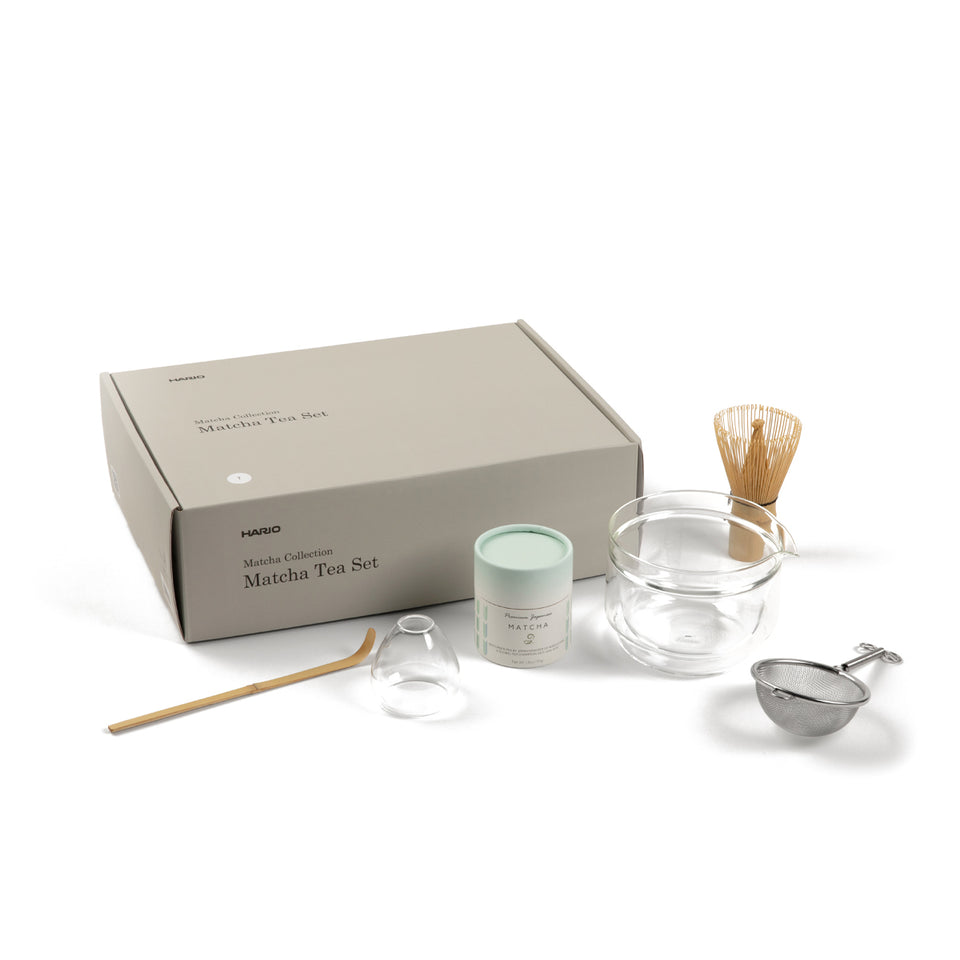
Ceremonial Matcha Gift Set — Hario × Japanese Green Tea Co.
Ceremonial matcha with a Hario double-walled glass chawan, a 100-prong bamboo chasen, a chashaku, and a sifter.
Now, this one breaks the rule from earlier. A chawan is not a consumable. It's an object; it has to live somewhere, and everything I said about gifts that don't linger argues against it.
I'd send it anyway, to one particular kind of person: someone who wants to make matcha at home and hasn't got the tools. The tools are the barrier, not the matcha. If that's your recipient, the object is the point and the rule doesn't apply. If it isn't — if you're sending to your mother-in-law out of obligation — send the tea and skip this.
On price, honestly.
Both sets sit above the ¥3,000–5,000 range above, and I'm not going to pretend otherwise.
That range is calibrated for domestic Japanese sending, often several boxes in one season, from a shop down the road. Sending one gift internationally is a different equation — you're likely sending one, not six, and freight is part of what you're paying for. If you're sending inside Japan to a Japanese recipient and you want to be precisely correct, buy locally in the customary band. If you're sending from the US to family, to a host, or to someone you want to give something they can't easily get, the calculus changes.
What I wouldn't do is send an expensive gift to someone who'll feel obligated to match it. That advice holds regardless of what's in the box.

Sending from the US
Most of this article assumes you're in Japan. If you aren't, start here.
The easiest version is to not ship anything.
Buy from a Japanese online store and have it delivered domestically inside Japan.
No customs, no quarantine, no three-week transit, no worrying about which regional window you'll hit.
Department store gift sites do this well, and it's what the custom is built around — they'll apply proper noshigami with the right wording, let you pick the delivery date so you land inside the window, and ship it for a fraction of international freight.
If you're sending to a Japanese recipient and you want it to be correct, this is the answer, and I'd rather say so than pretend every case is one we can serve.
When shipping from the US makes sense. When the point is that it came from where you are — something they can't get in Japan, or something you chose personally.
The gift is doing different work then, and a handwritten note explaining what it is does more than a printed label would. If you're sending to a Japanese family living in the US, all of the etiquette applies and none of these logistics do.
If you are shipping from here, four things to know.
Don't send meat. This one catches people, because ham and sausage sets are a classic ochūgen and the instinct is to send something similar from home.
Japan's animal quarantine covers processed meat products — jerky, ham, sausage, bacon, nikuman, even confectionery containing meat — and imports from many countries are blocked outright depending on disease status.
A US ham gift set is likely to be destroyed at the border, and your recipient may hear about it before you do.
Tea has no equivalent problem, which is part of why I keep recommending it for this. Worth a check against current rules regardless, since quarantine lists change.
Alcohol is a poor choice too. Beer and sake are staples of the domestic gift list and awkward as international shipments — liquor tax sits outside the small-value exemption below, and shipping alcohol internationally is its own headache.
Japan generally does not charge customs duty or consumption tax on imports with a customs value of ¥10,000 or less (about US$65).
For items imported for personal use, Customs often calculates the customs value at around 60% of the retail price, so the practical retail limit is roughly ¥16,666 (about US$110).
This is only a general guideline, though, as the final value is decided by Customs. Different rules apply to alcohol, tobacco, and certain leather goods.
Splitting one order into multiple packages to try to stay below the customs threshold is another common mistake.
In practice, this usually doesn't work. Japanese Customs may combine their values when assessing duties and taxes if several parcels from the same sender arrive for the same recipient around the same time.
It's also important to allow plenty of time for delivery. It's always unexpected when it happens with international delivery.
Ochūgen (お中元) is tied to specific seasonal dates, and in some regions the gift-giving period lasts only about two weeks.
International shipping and customs clearance can easily cause delays, so don't leave it until the last minute.
If you're hoping your gift arrives during an early July ochūgen (お中元) period, plan to ship it in June.
You won't get proper noshigami. A parcel from the US arrives as a parcel from the US. If the formal presentation matters — a business relationship, a senior recipient, in-laws you're trying to impress — the better move is ordering from a Japanese retailer for domestic delivery, with noshi service and the correct wording.
Department stores do this well, and it costs less than international freight. I'd rather tell you that than pretend every situation is one we can serve.
When to send from the US anyway. The point is that it's from where you are. Something the recipient can't get in Japan, or something with your hands on it.
In that case, the gift is doing different work, and a handwritten note explaining what it is and why does more than a printed label would.
Phone number. In case of a missed delivery, including the recipient's phone number would be a safe choice.
Japanese delivery companies can often coordinate re-delivery, pickup, or changing the delivery date by phone number to track their registered account.
They often use it to coordinate deliveries, and having it can help avoid delays. If a delivery is missed, it's not a major issue — redelivery is a normal part of the system, and the recipient can easily arrange another delivery using the notice left by the courier.
One final note: If you are sending an ochūgen (お中元) gift in the US, I think the gesture is to show that you acknowledge the Japanese custom, and people who receive it would be so surprised that you know the ochūgen (お中元) custom.
The timing should be the same, but you don't have to worry too much about the rules; the gift itself shows you care.
Quick Reference
Timing by region
| Region | Window |
| Kantō, Tōhoku | July 1 – July 15 |
| Hokuriku / Hokushin'etsu | Kanazawa area July 1–15; Japan Sea side July 15 – August 15 |
| Hokkaidō | July 15 – August 15 |
| Tōkai, Kansai, Chūgoku, Shikoku | July 15 – August 15 |
| Kyūshū | August 1 – August 15 |
| Okinawa | Lunar July 15 — date moves annually |
| Unsure? | Arrive July 1–15. Early is fine everywhere; late is the problem. |
If you've missed the window
| Label | When | Reading |
| 御中元 | Within the regional window | Ochūgen |
| 暑中お見舞い | After the window, before risshū (Aug 7 or 8) | Shochū-mimai |
| 残暑お見舞い | Risshū through end of August | Zansho-mimai |
| 暑中お伺い / 残暑お伺い | Same dates, recipient is senior to you | Shochū-o-ukagai / Zansho-o-ukagai |
| 御礼 | Any time — one-off thanks, no annual commitment | Orei |
Budget by recipient
| Recipient | Typical | Approx. USD |
| Parents, parents-in-law | ¥3,000–10,000 | $20–65 |
| Relatives | ¥3,000–5,000 | $20–35 |
| Teachers, instructors | ¥3,000–5,000 | $20–35 |
| Important business relationships | ¥5,000–10,000 | $35–65 |
Before you send
| Check | Why |
| Where does the recipient live? | Sets the window |
| Can they legally accept it? | Public servants, hospital staff, public school teachers, compliance-restricted firms |
| One-time thanks, or ongoing? | 御礼 vs 御中元 |
| Shipping or handing over? | Uchi-noshi vs soto-noshi |
| Anyone in mourning? | Plain kakegami, no noshi or red-and-white mizuhiki |
| Sending internationally? | No meat, no alcohol, allow weeks, order in Japan for proper noshigami |
Last updated: [August 2026]
Related products

10 reviews
$179.00 USD
$159.99 USD
USD
/
The Sencha Lover Gift Set - Premium Japanese Green Tea Set Package


Get Free Bonus Books

Sign up for free to the Green Tea Club to get advice and exclusive articles about how to choose Japanese Tea, and tips, tricks, and recipes for enjoying Japanese tea.
About the author

Kei Nishida
Author, CEO Dream of Japan
Certification: PMP, BS in Computer Science
Education: Western Washington University