Table of contents
Download Printable Recipe PDF Now
Introduction

You know what's funny? Every time I glance at my phone these days, something catches my eye.
Seriously, open up Instagram or TikTok, and I bet you'll scroll past a matcha latte in no time — bright green, foamy, and usually hanging out beside some ridiculously cute plushie or a sticker of a wide-eyed cartoon critter.
It's like matcha and cuteness go hand in hand. You see the same cafés, same types of photos, same crowd posting about it. Wild, right?
At first, I honestly thought it was just random. But now? Not a chance.
Digging a little deeper, though, I realized there's an actual thread tying all this together: Japan's kawaii (可愛い) culture, a bunch of surprisingly nerdy academic studies, and the reason Gen Z suddenly can't get enough of a centuries-old tea.
So, naturally, I fell down the rabbit hole. Stick with me — it's a wild ride. Plus, there's a cookie recipe at the end. (Trust me, you'll want to try it.)

Wait — What Does "Kawaii" Actually Mean?
Most people translate kawaii as "cute." That's close, but it misses something.
Cute in English can be a little dismissive — "oh, that's cute" — almost a brush-off. Kawaii doesn't carry that. Researchers describe it as a warm draw toward something you want to look after: round, small, a bit helpless, the kind of thing that makes you go "aww" and soften a little.
That feeling isn't only Japanese, of course. But Japan built a whole visual language around it — and then sent that language around the world.
Kawaii Has a Much Longer History Than You'd Think
This is the part that surprised me most, so stay with me for a minute.
The appreciation for small, endearing things shows up in Japanese writing as far back as the year 1000. In The Pillow Book (枕草子), the Heian-court writer Sei Shōnagon (清少納言) lists the things that please her — and a lot of them are small. A baby's small finger. A duckling. Anything miniature, she suggests, is all the more lovable for it. Centuries later, during the Edo period, the same affection for the small and charming surfaced in woodblock prints.

Kuniyoshi Utagawa Ukiyoe "Cats Suggested as The Fifty-three Stations of the Tōkaidō"
Then science caught up. In 1943, the Austrian researcher Konrad Lorenz described what he called the "baby schema" — the idea that a big head, large eyes, round cheeks, and a small nose automatically trigger a protective, caregiving response in us. It's wired in. It's why puppies, babies, and most cartoon mascots share roughly the same face.
Fast forward to the 1970s and '80s, and kawaii went from a quiet sensibility to a cultural takeover. Cute handwriting, cute characters, cute everything — it ran through Japanese pop culture and started diffusing throughout East Asia.
For a long time, though, nobody took it seriously. It got written off as a shallow teenage-girl fad, not something worth studying.
That started to shift in the 1990s, when sociologists (Sharon Kinsella's work is the one people still cite) began asking harder questions — about gender, about consumer culture, about whether all this cuteness was a kind of soft rebellion against the pressure to grow up and fall in line.
And here's where it gets genuinely interesting.
When Cute Got Serious: The "Power of Kawaii" Study
In 2012, a research group led by Professor Hiroshi Nittono (入戸野 宏) at Hiroshima University (広島大学) ran a set of experiments and published them in the journal PLOS ONE. The title pretty much says it: "The Power of Kawaii."
Here's what they did. They had university students do a task that needed real focus and a steady hand — at one point, literally the kids' game Operation. Then the students looked at a set of images. One group saw cute baby animals. Another saw grown animals.
The students who looked at the baby animals got better at the careful task afterward — markedly so. Looking at cute things didn't just make people feel good. It narrowed their attention and made them more careful.

Think about what that means. The cute sticker on someone's laptop, the round little mascot on the matcha tin — that stuff might actually be doing something to how we concentrate.
By 2016, this had grown into its own academic field. A scholar named Joshua Paul Dale edited a special issue of the East Asian Journal of Popular Culture and named it "Cute Studies." Cute had officially become a subject you could research, just like film or fashion. (One of the papers in that very issue was about kyaraben — character bento — the art of turning a kid's lunch into a tiny, cute scene. Hold that thought; we're coming back to cute food.)
These days, the research has gone practical — people are studying how cuteness affects mental health, how to design friendlier robots and AI, and, yes, how it moves products off shelves.
So that's the backdrop. Cute is old, it's wired into us, and it works. Now let's talk about the green stuff.
Why Gen Z Fell Hard for Matcha
Matcha (抹茶) is not new. It's been part of Japanese tea culture for centuries — the powdered green tea you whisk into a froth.
What's new is the scale.
Somewhere around 2024 and 2025, matcha stopped being a niche specialty and became a genuine global craze, and a younger crowd led the charge. The usual reasons get cited: it's caffeine, but a gentler kind, the sort that doesn't tend to give you the hard crash coffee can. People started calling it "clean caffeine." It photographs beautifully — that green is unmistakable. And social media did the rest. One viral autumn and demand went vertical.

The numbers are somewhat wild. Japan produced a record 5,336 tons of tencha (てん茶) — the shade-grown leaf that becomes matcha — in 2024, and it still wasn't enough. That's roughly 2.7 times what was produced a decade ago, according to Japan's Ministry of Agriculture, Forestry and Fisheries (農林水産省, or MAFF). And in April 2025, MAFF announced a real shift — for the first time, the tea industry's official direction is pivoting from domestic consumption toward exports, with tencha and organic tea named as priorities.
Here's a detail I didn't know: only about 6% of all the tea grown in Japan is the kind used for matcha. It was a small corner of the industry. The boom is forcing the whole thing to reshape itself.
(If you've had trouble finding your usual matcha lately — now you know why.)
Where Kawaii Meets Matcha
So you've got two things happening at once.
A whole generation discovering matcha. And that same generation raised on kawaii — characters, mascots, cute cafés, things designed to make you go "aww."
They were always going to collide.
Walk into a matcha café aimed at a younger crowd, and the drink is only half of it. There's the cup design, the little mascot, the photogenic foam art, and sometimes a whole character theme. The matcha is the flavor, but the cuteness is the experience.

It makes sense when you remember that green is one of the friendliest colors to work with visually, and matcha desserts are basically built for it — soft green sponge, pale green cream, that gentle color that reads as wholesome and a little playful at the same time.
And cute food has deep roots in Japan, like that kyaraben tradition the researchers studied. Turning food into something appealing and characterful isn't a gimmick there — it's almost a craft.
(I went deeper into this entire connection — kawaii, kyaraben, and how it ties into Japanese tea culture — in an earlier piece. If you want to keep going down this rabbit hole, the Kawaii and Japanese Food Culture section of "Kawaii & Japanese Green Tea" is the one to read next.)
Which brings me to the fun part.
If matcha and cute belong together, the most satisfying way to prove it is to make something. So let's bake a batch of cute little matcha cookies.
But before we shape any dough — one quick aside, because there's a piece of this story that's just too good to skip.
Wait, Was Totoro Even Supposed to Be Cute?
Here's where the story gets really good.
If matcha plus kawaii is the perfect example of cute as a cultural force, Totoro might be the perfect example of all.
And the wild part? Hayao Miyazaki (宮崎駿) never intended him to be cute.
I know. Bear with me.
Miyazaki Didn't Want a Mascot
When Miyazaki designed Totoro, he deliberately avoided traditional "cute." In his mind, Totoro wasn't a cuddly companion — he was an inscrutable old forest creature with a blank, ancient expression. Something a little uncanny. Miyazaki has said elsewhere that an artist who's too conscious of trying to make something cute usually ends up ruining the drawing.
He famously played a prank about exactly this at a Studio Ghibli hiring interview. He told a room of applicants, with a grin, "I don't think Totoro is a cute creature. He is a dreadful creature. He's a carnivore, and the reason why he didn't eat Satsuki and Mei was that he wasn't hungry."
Most of the applicants froze.
One of them, an animator named Kenji Itoso (糸曽 賢志), had rewatched the film right before the interview and remembered something — Totoro has flat molars. Flat teeth are herbivore teeth. So he pointed it out. Totoro couldn't be a carnivore; he eats acorns.
He got the job.
(I love that story so much. It says everything about how seriously Miyazaki thought about this stuff.)

With Totoro in Hawaii
Totoro Was Actually a Box Office Flop
This part genuinely surprised me. When My Neighbor Totoro (となりのトトロ) came out in 1988, it didn't do well at the box office. Studio Ghibli was in real financial trouble. The film didn't break even until about two years later, when a toy company started making Totoro plushies, and they took off in a way nobody expected.
The plushies saved Ghibli. Cute saved Ghibli.
Imagine being Miyazaki — having deliberately designed a primeval forest spirit you specifically didn't want to be a cute mascot — and watching the world turn him into the most beloved stuffed animal of a generation.
There's a lesson in there about how kawaii works. And about how completely it can override even the creator's intent.
So, Why Are We Baking Totoros?
Honestly? I'm a big Totoro fan — have been for years.
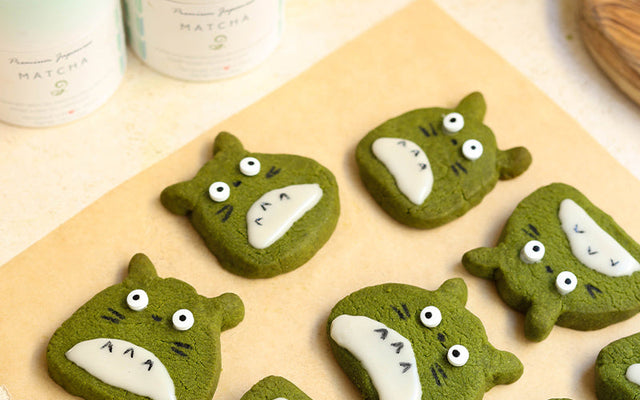
And these little guys are about as cute as a cookie gets. Round, green, and they'll look great next to a matcha latte.
Let's bake.
Let's Make Something Cute: Totoro Matcha Shortbread Cookies
videoid="_s-bCR-Hkhc"
Download Printable Recipe PDF Now
These are matcha shortbread — buttery, a little crumbly, with that gentle grassy matcha flavor — shaped into a plump, round forest creature with two pointy ears and a soft cream tummy. They're easier than they look, and the dough is forgiving.
One real tip up front, and it matters: bake them low and slow. Matcha's green dulls and turns brownish if the oven is too hot. A low temperature keeps that color bright.
Makes about 12–14 cookies
For the dough:
- 115 g (½ cup / 4 oz) unsalted butter, softened
- 50 g (¼ cup) powdered (icing) sugar
- 150 g (1¼ cups) plain flour
- 1 tbsp (about 6 g) culinary-grade matcha, sifted
- A pinch of fine salt
- ½ tsp vanilla extract
For the faces:
- 50 g (1.8 oz) white chocolate, melted (for the cream tummy)
- Black sesame seeds, or a little melted dark chocolate (for the eyes)

Make it:
- Beat the softened butter and powdered sugar together until pale and smooth.
- Add the vanilla. Sift in the flour, matcha, and salt. Mix gently until it just comes together into a dough — don't overwork it.
- Press the dough into a flat disc, wrap it, and chill for at least 30 minutes. Cold dough holds its shape; warm dough spreads.
- Heat your oven to 160 °C (320 °F) — yes, low. Line a tray with parchment.
- Roll the dough out to about 7–8 mm (a little over ¼ inch). For each cookie, shape a rounded body and pinch up two small pointed ears at the top. (No cutter needed — hands are fine, and slightly imperfect ones look more charming anyway.)
- Bake for 12–15 minutes. You want them set but barely colored — pull them before the edges brown.
- Let them cool completely on the tray. They firm up as they cool.
- To finish: spoon a small oval of melted white chocolate onto the lower belly for the cream tummy. While it's still soft, press two black sesame seeds near the top for eyes, and if you like, drag a toothpick to make a few little V-shaped tummy markings.
That's it. A tray of round green woodland friends, ready to sit next to your matcha latte and improve your concentration — at least, if Professor Nittono is right.

Download Printable Recipe PDF Now
A Quick Word on the Matcha You Bake With
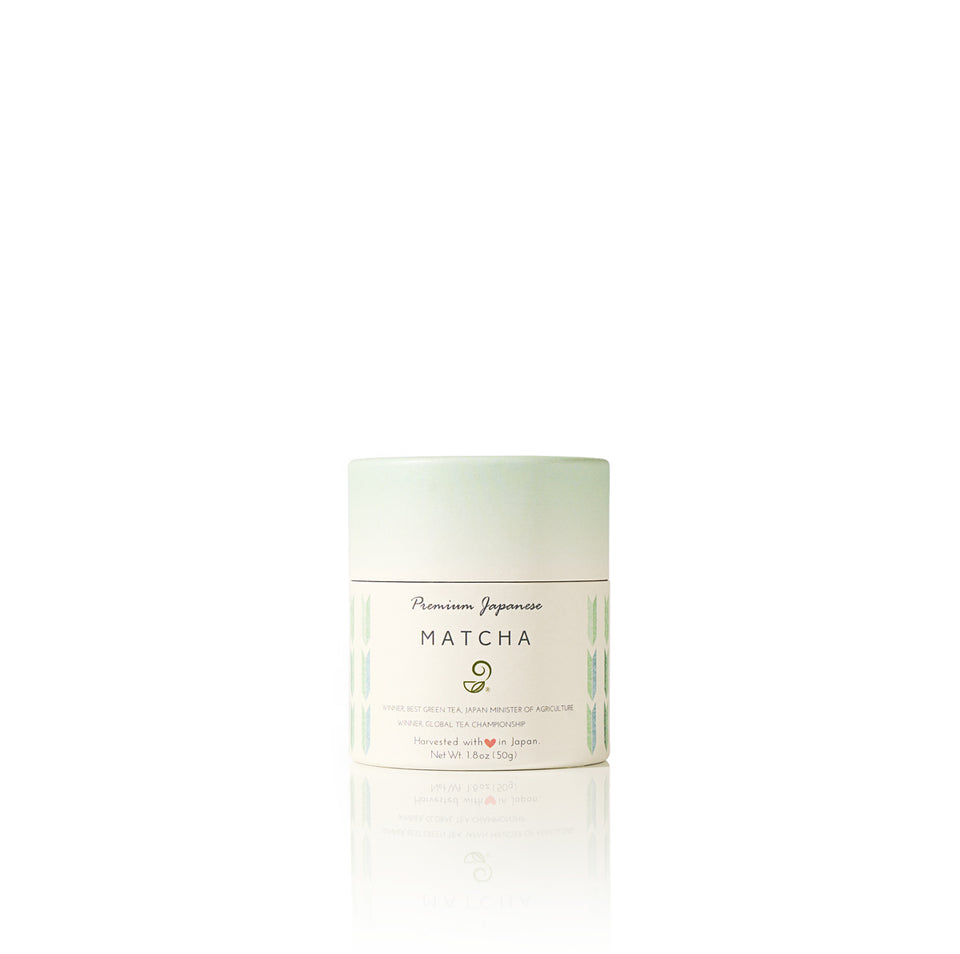
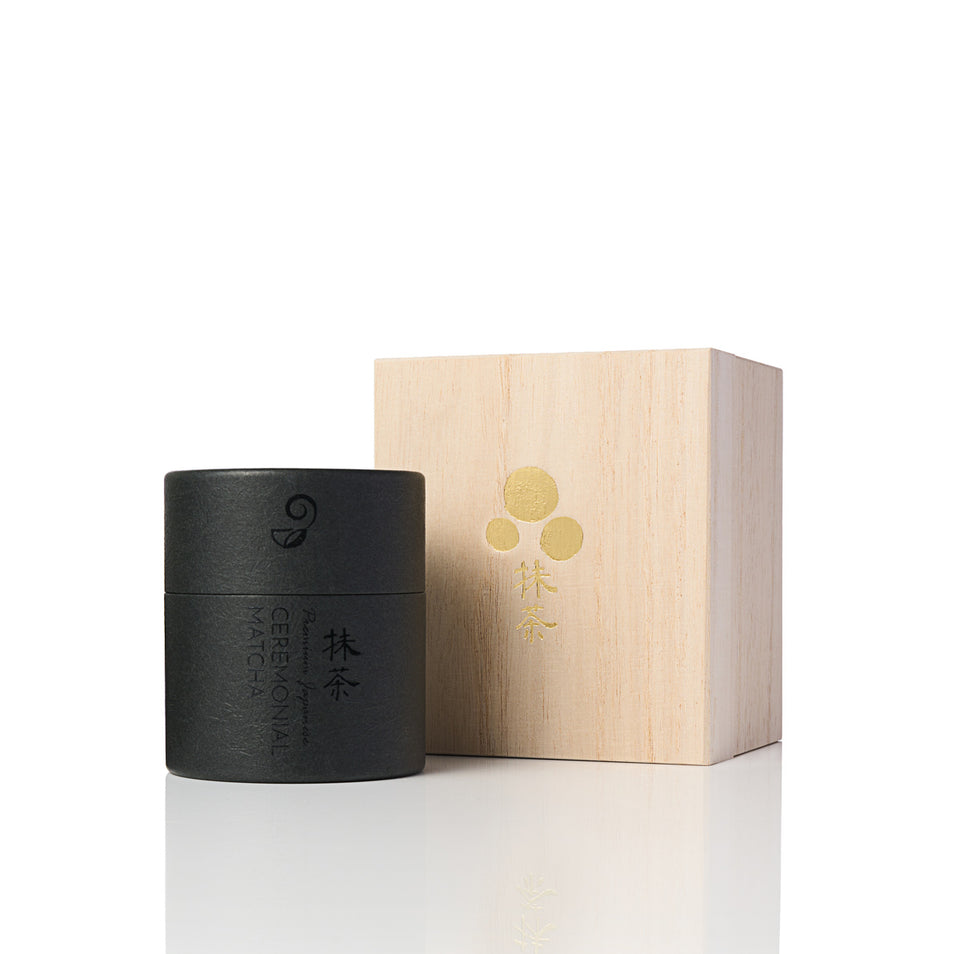
If you want the matcha in your cup to be as good as it gets, our Limited Reserve Ceremonial Matcha is the one to reach for — it's won the Global Tea Championship in the matcha category twice (2018 and 2025), and it's made for whisking and drinking.
For baking specifically, though, you don't need to use your best ceremonial. A good culinary-grade matcha is perfectly fine for cookies, cakes, and lattes — it holds its color and flavor through heat and stands up to butter and sugar without disappearing. And given how matcha prices have moved in 2025, saving the ceremonial for the cup just makes sense.
If you want the freshest possible matcha at home for the drinking side of things, our Cuzen Matcha Maker stone-mills tea leaves into powder fresh, right before you make your cup. It uses a real ceramic stone mill, turning slowly so there's no heat to damage the leaf, which is part of why the flavor comes through so cleanly.
Either way, the cookies are a good excuse to keep a tin around.
Conclusion
I went into this thinking matcha and cute stuff just happened to be popular at the same time.
I came out convinced they're the same story — an old culture of taking pleasure in small, charming things, a bit of real science behind why that works on us, and a generation that grew up fluent in both and turned a centuries-old tea into something new.
So make the cookies. Whisk the matcha. Put the little green creature next to your cup and take the photo — you've earned it.
And if you make a batch, I'd genuinely love to see how yours turn out. Which face came out the cutest?
Frequently Asked Questions
Why is matcha (抹茶) so popular with Gen Z right now?
Matcha is a powdered green tea made from shade-grown tencha (てん茶) leaves — the same drink the Japanese tea ceremony has used for centuries, now consumed mostly as lattes and iced drinks. The current boom is driven by a selection of factors: matcha's caffeine releases more slowly than coffee's because of the amino acid L-theanine, so it tends not to produce the same crash, which younger drinkers describe as "clean caffeine." Social media also rewards the color, since the bright green of matcha photographs unusually well, and a viral autumn in 2024 pushed demand up sharply. According to Japan's Ministry of Agriculture, Forestry and Fisheries (MAFF), tencha production has grown about 2.7 times in the past decade — to 5,336 tons in 2024 — and Japan's green tea exports rose 25% in value to 36.4 billion yen (~$252M USD) that same year. Even so, demand is outpacing supply.
What does "kawaii" (可愛い) actually mean — is it just "cute"?
Kawaii usually translates as "cute," but Japanese researchers describe it as a warmer and more active feeling — a draw toward something small and endearing that makes you want to look after it. The English word "cute" can carry a faintly dismissive edge ("oh, that's cute") that kawaii doesn't have. The aesthetic itself goes back at least to the Heian period (794–1185), where Sei Shōnagon's The Pillow Book lists small endearing things among life's pleasures. Modern kawaii culture took off in 1970s–80s Japan and is now a global visual language.
Is the matcha shortage real, and will it ease soon?
It is real, and it is unlikely to ease quickly. Japan produced a record 5,336 tons of tencha in 2024, but global demand grew faster, and 2025 heatwaves in Kyoto reduced the harvest by roughly 25%, pushing auction prices to record highs of 8,235 yen per kg, about a 170% increase year over year. According to a report from TIME, the rising global demand for matcha, combined with limited production capacity and unfavorable weather in important regions like Kyoto, has put additional strain on matcha supplies.
Does culinary-grade matcha work for baking, or do I need ceremonial?
Culinary-grade matcha is made specifically for cooking, and it works well in cookies, cakes, and lattes — it holds its color and flavor through heat and stands up to butter and sugar. Ceremonial-grade is finer and sweeter, made to be whisked and drunk on its own, so its subtle notes get lost when you mix it with melted butter or shaped dough. Given how much matcha prices have climbed in 2025, using culinary-grade matcha for baking is also the sensible choice: save the ceremonial for the cup.
Why bake matcha cookies at a low oven temperature?
Matcha's bright green is unstable above roughly 170 °C (338 °F) — the chlorophyll begins to break down, and the color shifts toward yellow-brown. Baking at 160 °C (320 °F) for 12–15 minutes keeps the green vivid while still setting the shortbread. Pulling the cookies before the edges color is also part of the trick — they finish firming up as they cool on the tray. If your oven runs hot, drop another 5–10 °C; matcha is forgiving on flavor but not on color.
Quick Reference: The Cookie at a Glance
| What you need to know | Details |
| Makes | About 12–14 cookies |
| Prep | 15 min + 30 min chill |
| Bake | 12–15 min at 160 °C (320 °F) |
| Key tip | Low oven temp keeps the matcha green bright |
| Matcha for baking | Culinary-grade is fine; save ceremonial for the cup |
| Decorate | White chocolate tummy + black sesame eyes |
Related products

• Disclosure: I only recommend products I would use myself, and all opinions expressed here are my
own. This post may contain affiliate links that I may earn a small commission at no additional cost to you.
The commission also supports us in producing better content when you buy through our site links.
Thanks for your support.
- Kei and Team at Japanese Green Tea Co.


Get Free Bonus Books

Sign up for free to the Green Tea Club to get advice and exclusive articles about how to choose Japanese Tea, and tips, tricks, and recipes for enjoying Japanese tea.
About the author
Kei Nishida
Author, CEO Dream of Japan
Certification: PMP, BS in Computer Science
Education: Western Washington University