Table of contents

Have you tried cheese tea?
If you haven't, I understand. The name sounds a little strange, and a lot of people imagine a piece of cheese floating in their tea. It is actually cold tea with a creamy foam made from cream cheese on top, and it has been very popular at tea shops in Asia for years (and more and more in the US too).
I remember going to a cheese tea shop in Seattle a few years ago. This time, we made our own version using our Yokohama Peach.
Please watch the video first. After the recipe, I will share everything I found out about cheese tea.
How to Make Yokohama Peach Cheese Tea
Makes 2 glasses · about 300 kcal per glass · 15 min prep + 20 min chill
Download Printable Recipe PDF Now
For the tea
- 4 teaspoons Yokohama Peach
- 2 cups (480 ml / 16 fl oz) cold water
- 1 ripe peach (about ½ cup / 120 ml of puree)
- Ice
For the cheese foam
- 4 tablespoons (about 60 g / 2 oz) cream cheese, at room temperature
- 1½ tablespoons sugar
- ¼ cup (60 ml / 2 fl oz) milk
- 3½ tablespoons (about 50 ml / 1.7 fl oz) heavy cream
Steps
- Add the Yokohama Peach powder to a glass or jar. Pour in the cold water and stir until it dissolves. Cover and chill in the fridge for about 20 minutes.
- Take the pit out of the peach and cut it into large chunks. Blend until smooth and keep the puree in the fridge.
- Make the cheese foam. Put the cream cheese, sugar and milk in a bowl and whisk with a handheld frother until smooth. (A blender works too.)
- In a separate cup, froth the heavy cream until it's foamy and airy. Be careful not to whip it too much.
- Add the frothed cream to the cream cheese mixture and mix well.
- Fill a tall glass with ice. Pour in ¼ cup (60 ml) of peach puree, then 1 cup (240 ml) of the chilled tea. Slowly pour the cheese foam on top.
- Finish with a light dusting of green tea powder. Take a few sips through the foam first, then stir and enjoy!
Download Printable Recipe PDF Now

That's it for the recipe!
If you are curious about where cheese tea came from and why it goes so well with green tea, please keep reading.
This recipe was Miki's idea
By the way, making a cheese tea with Yokohama Peach was Miki's idea.
As you may know, we are so honored that Okayama Kobo serves our Yokohama Peach.
So she thought if we had a good recipe, we could ask them to make one for their menu. That is how this recipe and the video came about.
(Team at Okayama Kobo, if you are reading this... (^^))

What Is Cheese Tea?
Cheese tea is cold tea (usually green tea, black tea or oolong tea) with a thick layer of foam on top. The foam is made with cream cheese, milk and cream, and most shops also add a little bit of salt to it.
In Chinese, it is called zhīshì nǎigài (芝士奶盖), which means something like "cheese milk cap." (Correct me if I am wrong (^^)) That's because the foam sits on top of the tea like a cap. In Japan, it is simply called チーズティー (cheese tea).
The foam is usually much thicker than the foam on a latte. It also stays on top instead of mixing into the drink, so you sip the tea through the foam.
Most shops use cream cheese. One shop in Los Angeles even had a cheddar cheese version on their menu (I will talk about that shop later), but that is pretty rare.
Cheese tea vs. milk tea and boba
With milk tea, the milk is mixed into the tea. With cheese tea, the foam stays on top, and the plain tea stays under it, so the first sip and the last sip taste quite different.
Many boba shops sell both, and some will add tapioca pearls under the foam if you ask. If you want to try that at home, please check our green tea bubble tea article for how to make the pearls.
What Does Cheese Tea Taste Like?
If I had to describe it, it is like the top part of a cheesecake, but lighter and a little salty.
The first sip is mostly foam, rich and a bit tangy from the cream cheese. What surprises a lot of people is the salt. It actually makes the foam taste sweeter, kind of like salted caramel.
After that, the cold tea underneath comes in and cleans up the richness. I think that is why so many people get hooked on it.
Our peach version is more fruity. The peach puree is at the bottom, the Yokohama Peach tea is in the middle and the foam is on top, so the taste changes a little with every sip depending on how much you tilt the glass.
We didn't add salt to the foam in this recipe. If you want the taste you get at tea shops, add a small pinch of salt to the cream cheese mixture in step 3 (I would start with a very small amount).
The History and Origin of Cheese Tea
Nobody seems to agree on who made the first cheese tea, so let me share what I found, step by step. (It turned out to be a bigger rabbit hole than I expected!)
The "milk cap" in Taiwan
Cheese tea is closely related to something called a milk cap, or nǎigài (奶蓋) in Chinese. A milk cap is a thick, lightly salted cream foam that sits on top of cold tea, and it is a regular item at tea stands in Taiwan, the same place that gave us bubble tea. A tea shop called LATTEA (綠蓋茶館) is often called the pioneer of milk cap tea there.
Cheese tea is basically a milk cap with cheese added to it. That's why one of its Chinese names is still nǎigài chá (奶蓋茶), "milk cap tea."
Taiwan's night markets, around 2010
Most stories say the cheese version started at night market stalls in Taiwan around 2010. The vendors whipped powdered cheese and salt with whipping cream and milk, and put it on top of cold tea. So the very first cheese teas used powdered cheese, not the cream cheese most shops use today.
By the way, the word for cheese depends on where you are. In Taiwan, cheese is usually qǐsī (起司). In mainland China and Hong Kong, it is zhīshì (芝士), which comes from the Cantonese way of saying "cheese."
Happy Lemon and the salted cheese topping
Happy Lemon is a tea chain that started in Taipei in 2006. It became known for its "salted cheese" drinks, a cream cheese foam on top of the drink sprinkled with rock salt.
Happy Lemon opened its first US shop in New York in 2013, and its first West Coast shop in Cupertino around 2015. Today it has about 2,000 shops around the world, including about 100 in the US.
Heytea and the three-hour lines
Cheese tea became really big in mainland China. In 2012, a 21-year-old named Nie Yunchen (聂云宸) opened a small tea shop called Royal Tea (皇茶) in an alley in Jiangmen, Guangdong.
He didn't like that many milk tea shops used powders and cheap ingredients, so he made his foam with real cream cheese (New Zealand Anchor cheese), milk, cream and salt. Because of a trademark problem with the name Royal Tea, the shop changed its name to Heytea (喜茶) in 2016.

When Heytea opened its first Shanghai store in 2017, people waited in line for up to three hours for one cup. Some people even paid others to stand in line for them!
(There were also reports later that some tea brands hired people to make their lines look longer. I guess the lines were part of the marketing too.)
In November 2018, Heytea opened its first store outside China, at ION Orchard in Singapore. Today it has more than 4,000 stores, mostly in China.

Heytea says they invented cheese tea. I am sure the night market vendors in Taiwan would say something different, so I will leave that one to you.
Cheese tea in the US and Los Angeles
Happy Lemon was already in New York from 2013, but cheese tea really caught on in the US around 2017. In August 2017, Little Fluffy Head Cafe opened on 7th Street in Downtown LA. The owner, Jenny Zheng, first tried cheese tea while she was living in China in 2016 and wanted to bring it to LA. Her menu had a classic foam, a crème brûlée foam and the cheddar cheese foam I mentioned earlier.
By December 2018, The New York Times was writing that cheese tea was already a hit in San Francisco.
I like this part because Downtown LA is also where you can order our Yokohama Peach now! Okayama Kobo in Little Tokyo has it on their drink menu (hot or cold), and so do their Anaheim and Laguna Niguel cafes.
Heytea itself came to the US in December 2023, with its first store in New York City, and by January 2025 it had 15 stores in New York. It now lists a store at South Coast Plaza in Costa Mesa too, so you can try the original in Southern California as well.
Cheese tea in Japan, the "post-tapioca" drink
Japan was a little later. In 2018, in the middle of the big tapioca boom, Japanese media started calling cheese tea the posuto tapioka (ポスト・タピオカ), meaning the next drink after tapioca.
In October 2018, the black tea brand Nitto Kocha (日東紅茶) served cheese tea at a pop-up Tea Stand in Tokyo Midtown Hibiya. Then in June 2019, a Taiwanese cheese tea chain called machi machi opened its first store in Japan at Laforet Harajuku.
So did cheese tea replace tapioca?
I don't think so, since you still see boba everywhere. But cheese foam became one of the toppings that many tea shops offer, and maybe that is a better result anyway.
Cheese tea timeline

- 2006: Happy Lemon starts in Taipei, Taiwan.
- Around 2010: Night market vendors in Taiwan top cold tea with powdered cheese, salt, cream and milk.
- 2012: Royal Tea (皇茶) opens in Jiangmen, China, using real cream cheese.
- 2013: Happy Lemon opens its first US shop in New York.
- 2016: Royal Tea is renamed Heytea (喜茶).
- 2017: Up to three-hour lines at Heytea in Shanghai. Little Fluffy Head Cafe opens in Downtown LA.
- 2018: Japan calls cheese tea the "post-tapioca" drink. Heytea opens in Singapore, its first store outside China.
- 2019: machi machi opens its first Japan store in Harajuku.
- 2023: Heytea opens its first US store in New York City.
Cheese Foam, Cold Foam and Sea Salt Cream
These three are easy to mix up because they look similar in the cup, but they are made differently.
| Foam | Made with | Taste | Where you usually see it |
|---|---|---|---|
| Cheese foam | Cream cheese, milk, heavy cream, sugar, often salt | Rich, tangy, a little salty | Tea shops, on cold tea |
| Cold foam | Cold milk frothed until thick. "Sweet cream" versions add cream and vanilla syrup | Light and sweet | Coffee shops, on iced coffee and cold brew |
| Sea salt cream | Cream and milk with sea salt, no cheese | Salty-sweet, lighter than cheese foam | Taiwanese cafes, like the sea salt coffee at 85°C Bakery Cafe |
Okayama Kobo has one like this too. At their Honolulu cafe, the signature drink is a Matcha Sea Salt Cold Brew, a caramel cold brew with matcha sea salt cream foam on top.
Why Green Tea Goes Well with Cheese Foam
Cream cheese foam is pretty rich, so it goes best with a tea that has some strength to it.
Sencha has a natural bitterness and astringency (the slightly dry feeling you get on your tongue). Some people find it too strong when they drink it plain, but under a rich foam, that bitterness keeps the drink from tasting too much like a dessert.
One of our customers, Jennifer, wrote something in her review that shows this really well. She said Yokohama Peach left an astringent aftertaste for her when she drank it hot. But when she made it iced with passionfruit juice, she said it was "so delicious and irresistible!!!"
I think it works the same way with cheese tea. The bitterness that can feel strong in a hot cup goes nicely with fruit and cream in a cold drink.
About Yokohama Peach
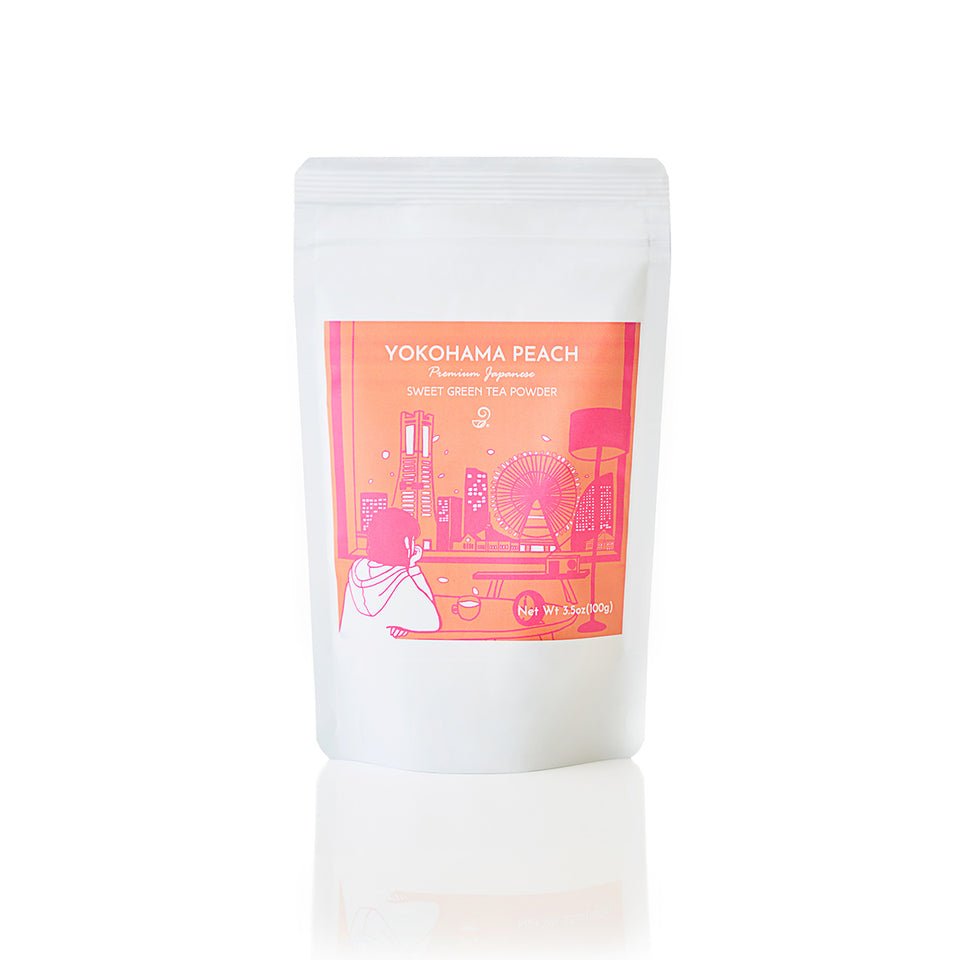
Yokohama Peach is a powdered sencha made from the Yabukita (やぶきた) cultivar, with peach and a light sweetness added. We made it after our customer survey, where many of you told us you wanted a sweeter tea (sweet, but not too sweet!).
It is part of our Modern Japan City Series, and the name comes from the bright and fashionable feel of the city of Yokohama (横浜). The package was designed by our Chief Branding Officer, Miki Pon.
What I like about using it for cheese tea is that you don't need to brew it. Most cheese tea recipes ask you to brew the tea hot and then wait for it to cool down, but Yokohama Peach dissolves in cold water if you just stir it, so you only need to chill it.
The package says 2 to 3 teaspoons for an 8 oz (240 ml) cup. In this recipe we use 4 teaspoons for 2 cups, which is on the lighter side, because the peach puree and the foam also add sweetness.
If you want to try it, this is the one we used in the video.

Tips for a Thick, Smooth Cheese Foam
-
Use cream cheese at room temperature. Cold cream cheese leaves small lumps that are hard to get rid of, even with a frother. I would take it out of the fridge about 30 minutes before, or warm it in the microwave for a few seconds.
-
Don't whip the cream too much. It should be thick but still pourable, a bit like melted ice cream. If it holds stiff peaks, it will sit on top of the tea in clumps.
-
Make the foam last. It tends to get looser as it sits, so mix it right before you pour.
-
Pour slowly. Pouring the tea and the foam over the back of a spoon helps keep the layers.
-
Salt is up to you. A small pinch gives you the tea shop taste. Without it, the foam tastes more like cheesecake.
- A handheld frother is enough. In the video, we used a small handheld frother for both the cream cheese and the cream. It is the same one we use for matcha.

How to Drink Cheese Tea
Many tea shops tell you not to use a straw at first, because a straw goes straight down to the tea and you miss the foam.
Instead, tilt the cup to about 40 to 45 degrees and drink from the edge, so you get the foam and the tea together. A lot of shops even give you a lid with a small opening just for this.
With our version, there is peach puree at the bottom too. So I would take a few sips through the foam first, and then stir everything together.
(And yes, you will probably get a foam mustache. That's part of the fun!)

Peach Season and Peach Swaps
Fresh, ripe peaches make the best puree, so summer to early fall is the easiest time to make this.
In Japan, peach (momo, 桃) is a big summer fruit. Yamanashi (山梨) has grown the most peaches of any prefecture since 1966, about one out of every three peaches in Japan, and Fukushima (福島) is second. Okayama is also famous for peach!

A peach orchard in Okayama
When peaches are out of season, frozen peach slices work fine in the blender. You can use canned peaches too, but please drain the syrup first, or the drink will get very sweet.
One of our reviewers, Vanna, wrote that the peach flavor in Yokohama Peach is not like American peaches to her. She said it tastes like "the big sweet pink ones from Japan." That made me happy to read. (^^)
Other Cheese Teas You Can Make with Our Teas
Once you know how to make the foam, you can put it on other teas as well. These are the ones I would like to try next.
Tokyo Peppermint cheese tea
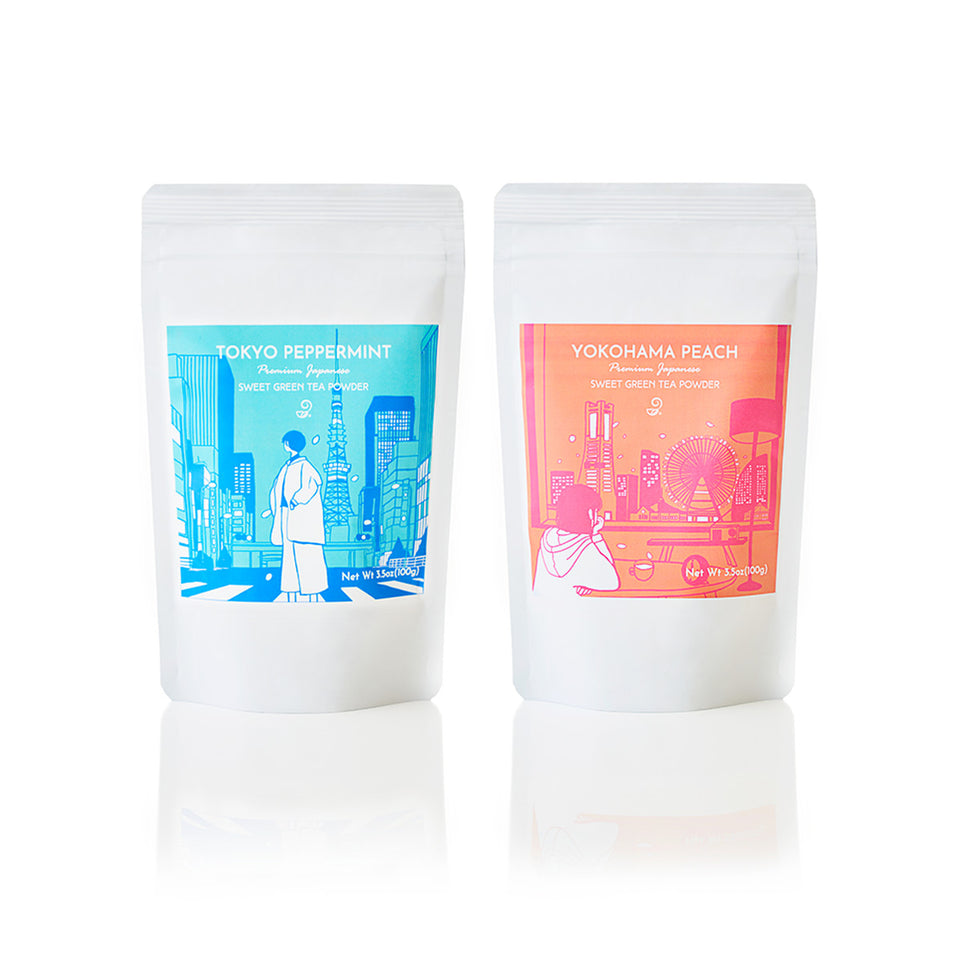
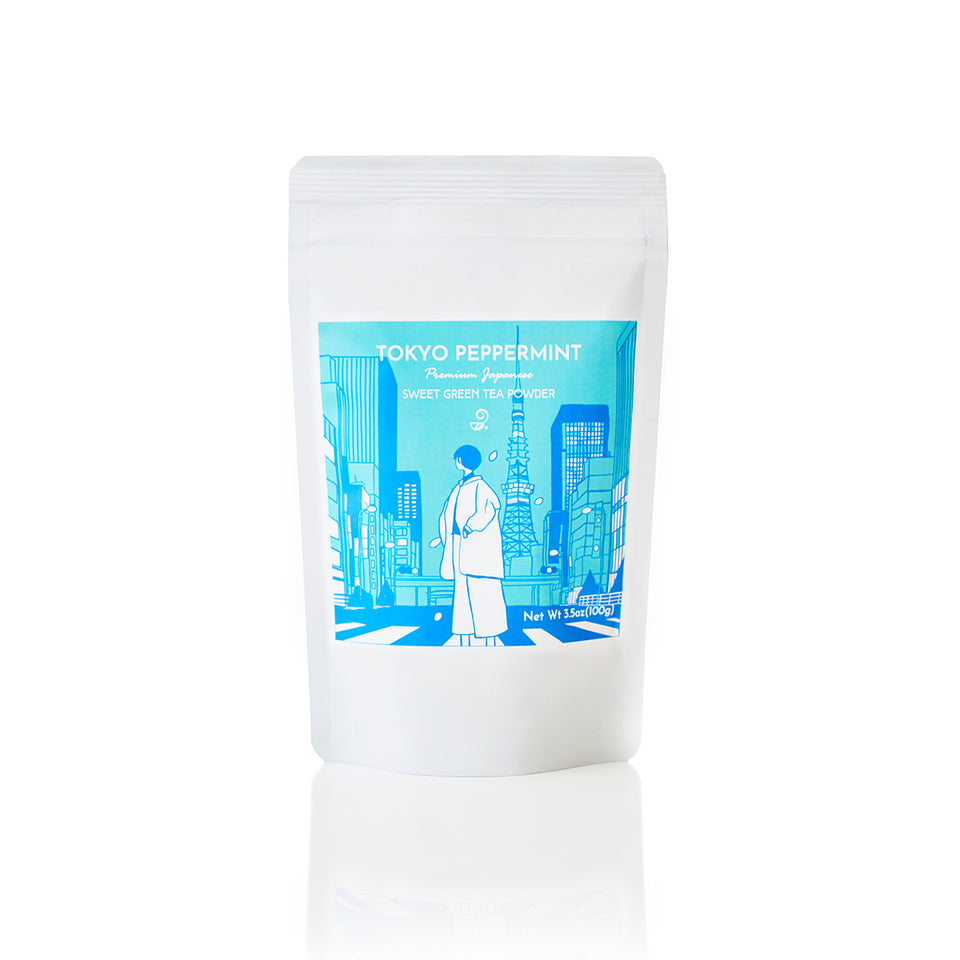
You can use Tokyo Peppermint instead and skip the peach. It is the same sweetened sencha powder but with peppermint instead of peach, so the foam steps stay exactly the same.
If you can't decide, the Tokyo Peppermint and Yokohama Peach set comes with both.
Matcha cheese tea
Matcha cheese tea is one of the most common cheese teas at tea shops in Asia. Whisk matcha with a little water first, then add cold water and ice.
Matcha is not sweetened like Yokohama Peach, so you will probably want to add some sugar or syrup to the tea. Our 10 ways to sweeten matcha article has some ideas.
Hojicha cheese tea
Hojicha and cream cheese go well together. Actually, our Hojicha Banana Daifuku uses a cream cheese filling with Hojicha Powder.
For a drink, mix the Hojicha Powder into cold milk or water and put the same foam on top.
Is Cheese Tea Healthy?
Honestly, cheese tea is more of a treat. Our recipe is about 300 kcal per glass, and most of it comes from the foam.
If you want to make it lighter, I would reduce the sugar in the foam first, since Yokohama Peach and the peach puree are already sweet. You can also use light cream cheese, although the foam tends to be a little thinner.
Also, it is still green tea, so it has caffeine. And the foam is dairy, so even though Yokohama Peach itself is vegan, this drink is not.
Quick Reference
| Drink | Yokohama Peach Cheese Tea |
| Makes | 2 glasses |
| Time | 15 min prep + 20 min chill |
| Calories | About 300 kcal per glass |
| Tea | 4 tsp Yokohama Peach in 2 cups (480 ml / 16 fl oz) cold water |
| Cheese foam | 4 tbsp (60 g / 2 oz) cream cheese, 1½ tbsp sugar, ¼ cup (60 ml) milk, 3½ tbsp (50 ml) heavy cream |
| Fruit | 1 ripe peach, blended (¼ cup / 60 ml per glass) |
| Tool | Handheld frother or a blender |
| The tea | Yokohama Peach, lightly sweetened sencha powder with peach, 3.5 oz (100 g) bag |
Final Thoughts
When I started looking into cheese tea, I didn't expect the story to be this long. Most of it happened in only the last 15 years or so, and the drink went all the way from night market stalls in Taiwan to tea shops in New York and Los Angeles.
What I like most is how easy it is to make at home. You don't need a special machine, just cream cheese, milk, cream and a frother, and the foam works on almost any cold tea. With Yokohama Peach, you don't even need to brew the tea, so it's ready as soon as it's chilled.
If you have never tried cheese tea because the name sounds a little strange, I hope this article gives you a reason to try it at least once.
If you make it, please let me know how your foam turned out! And which one would you like to try next, peach, peppermint or hojicha? (^^)
P.S. We are running a promotion right now! Every order in the USA gets 1 free single-serve pack of Yokohama Peach, while supplies last. So if you want to try this cheese tea, now is a good time. (^^)
Download Printable Recipe PDF Now
Related products

1 review
$50.00 USD
$44.99 USD
USD
/
Tokyo Peppermint - Yokohama Peach - Sweet Powder Tea Set Package


Get Free Bonus Books
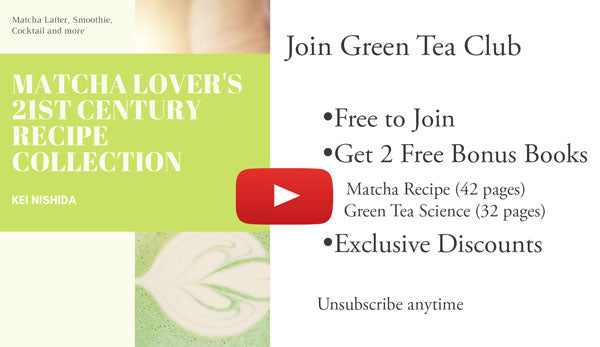
Sign up for free to the Green Tea Club to get advice and exclusive articles about how to choose Japanese Tea, and tips, tricks, and recipes for enjoying Japanese tea.
About the author

Kei Nishida
Author, CEO Dream of Japan
Certification: PMP, BS in Computer Science
Education: Western Washington University