On the September 21st, 2018 issue of J-Weekly, Kei Nishida's article about Japanese green tea was featured on the full page.
J-Weekly is a Japanese newsletter in the San Francisco Bay Area and Northern California, circulating 33,000 copies every Friday.

J-Weekly approached Kei to write about Japanese green tea in their special fall gourmet issue.
Kei wrote an article explaining the differences between the three popular types of Japanese green tea: Matcha, sencha, and Gyokuro.

If you do not read Japanese, Kei has written a similar article explaining different types of Japanese green tea.
FAQs about Japanese-American Community Press and Tea
What does it mean when a Japanese tea brand gets featured in Japanese-American community publications?
Press features signal industry recognition and broader cultural relevance beyond the brand's core customers. J-Weekly is a Japanese-American community publication serving the bicultural audience that bridges Japan and the U.S. Coverage in Japanese-American community media specifically reaches consumers with strong cultural-Japanese affinity, which is a high-fit audience for premium Japanese tea products. For specialty tea brands specifically, third-party press coverage helps build credibility with audiences who don't yet know the brand directly — newspapers, magazines, and trade publications carry editorial weight that direct-marketing doesn't.
That said, press coverage isn't the same as quality. Some heavily-covered tea brands produce mediocre tea; some excellent specialty tea brands have minimal press presence because they prioritize product over PR. Press coverage is one signal among many, not a substitute for direct evaluation.
For customers, press features can be a useful discovery mechanism — articles reviewing or featuring tea brands often introduce readers to specialty brands they wouldn't have found through other channels. The discovery value works in both directions; consumers find brands, brands find new audiences.
Where can I find independent reviews of Japanese tea brands beyond press features?
Steepster is the largest user-driven tea review platform — thousands of teas rated by drinkers. Reddit's r/tea community discusses brands at length. Specialty tea publications (Tea Magazine, World Tea News, T Magazine) provide more in-depth editorial review.
Specialty importer blogs (Yunomi, Hibiki-an, Senbird) often include detailed tasting notes for each tea they carry — these are essentially marketing but written by people who genuinely understand the products. Cross-checking a tea's description across multiple retailers' reviews of the same tea gives you a realistic picture of quality.
YouTube tea reviews from established channels (Mei Leaf, Yunomi, Per Oscar Brekell) are increasingly the reliable format — you can see and hear the reviewer's actual experience with the tea, which catches nuance that text reviews miss.
Why do Japanese tea companies prioritize media presence in addition to direct sales?
Three reasons. First, customer acquisition: media coverage reaches audiences that direct-marketing channels miss — readers of general-interest publications don't see specialty-tea ads but may read editorial coverage. Second, brand authority: third-party coverage carries weight that self-promotional content doesn't, which builds credibility for customers researching the brand.
Third, cultural representation: for Japanese tea companies operating internationally, media coverage helps explain Japanese tea culture to Western audiences. This educational role is valuable for the broader specialty tea category, not just any single brand. Companies that participate in cultural education benefit from category growth even when individual articles don't directly drive sales.
This is also why Japanese tea companies often participate in tea festivals, give presentations at industry events, and produce educational content. The category-building work pays off over years rather than weeks.
How do specialty tea brands like JPCo build long-term reputation?
Through consistency over years. Specialty tea reputation isn't built through marketing campaigns; it's built through sustained product quality, transparent supply chains, customer service, and credible cultural authority. Brands that maintain these standards over a decade end up with reputations that newer brands can't easily match. The Sencha Lover Gift Set is from a brand operating on this long-term reputation logic — the gift set quality is calibrated against years of customer feedback rather than just marketing-launch needs.
Press coverage, awards, and industry recognition follow from sustained quality rather than producing it. Brands that try to build reputation through PR alone tend to fade quickly when product reality doesn't match the marketing.
For customers, this means: brands with long histories of consistent quality are usually safer bets than buzzy newcomers, even if the newcomers have better-looking websites. Track records matter for tea brand selection.
Are press features and awards reliable indicators of which Japanese tea to buy?
Partially reliable, with caveats. Awards from credible tea-industry organizations (Global Tea Championship, World Tea Awards, regional Japanese tea competitions) reflect actual quality assessment by trained tasters — meaningful signal of tea quality. Press features in established publications also tend to be earned rather than purchased.
Less reliable: "as featured in" claims that don't specify which publication or what kind of feature, generic "award-winning" claims without specifying the award. These can be marketing dressing rather than actual recognition.
Practical: use press features and awards as one input among several when researching a tea brand. Combine with direct customer reviews, sample purchases, and your own taste preferences. No single signal (including awards) replaces actual experience with the tea.
READ BOOKS BY KEI NISHIDA
Book - I Will Teach You How to be Healthy by Using Japanese Green Tea!
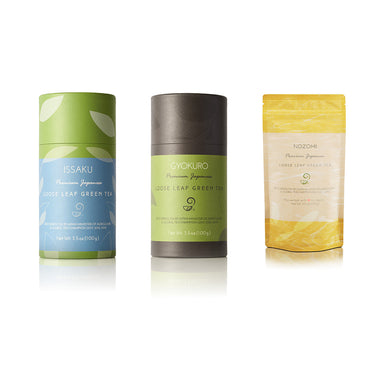
The Sencha Lover Gift Set - Premium Japanese Green Tea Set Package
This tea set features three exceptional Japanese green teas, each crafted with care and traditional techniques. Issaku Reserve, a Global Tea Champion winner in 2017 and 2019, is a rare masterpiece created by Farm Master Mr. Arahata at Arahataen Green Tea Farm. Handpicked once a year from the first flush and processed with advanced methods, Issaku represents the highest-grade deep-steamed green tea, available only in limited quantities even in Japan.
The set also includes Gyokuro, a premium shaded green tea known for its rich, sweet flavor and deep mossy green color. Grown under special mats for 20 days to increase caffeine and amino acid levels, Gyokuro offers a layered, smooth taste unlike any other. Completing the collection is Nozomi, a fine Kabuse-cha, or "Covered Green Tea," carefully grown under nets to gently shade the leaves just before new sprouts emerge, resulting in a soft, rich, and refined flavor profile.
Related Articles You May Be Interested
Get Free Bonus Books
Sign up for free to the Green Tea Club to get advice and exclusive articles about how to choose Japanese Tea, and tips, tricks, and recipes for enjoying Japanese tea.
Unsubscribe anytime. It’s free!
About the author
Kei Nishida
Author, CEO Dream of Japan
Certification: PMP, BS in Computer Science
Education: Western Washington University
Kei Nishida is a passionate Japanese green tea connoisseur, writer, and the founder and CEO of Japanese Green Tea Co., a Dream of Japan Company.
Driven by a deep desire to share the rich flavors of his homeland, he established the only company that sources premium tea grown in nutrient-rich sugarcane soil—earning multiple Global Tea Champion awards.
Expanding his mission of introducing Japan’s finest to the world, Kei pioneered the launch of the first-ever Sumiyaki charcoal-roasted coffee through Japanese Coffee Co. He also brought the artistry of traditional Japanese craftsmanship to the global market by making katana-style handmade knives—crafted by a renowned katana maker—available outside Japan for the first time through Japanese Knife Co.
Kei’s journey continues as he uncovers and shares Japan’s hidden treasures with the world.