

Table of contents
Introduction
We are so excited to announce that Japanese Green Tea Co. is now an authorized retailer of Cuzen Matcha!
If you haven't heard of Cuzen Matcha yet, you're about to. And if you have — you probably already know why we're excited.
Cuzen makes an award-winning countertop machine that grinds whole organic matcha leaves into fresh matcha right on your kitchen counter. TIME Magazine named it one of the 100 Best Inventions of 2020. It won a Good Design Award in Japan. It picked up a CES Innovation Award. The list goes on.
But here's the thing — before we talk about the machine, we want to tell you about the person behind it.
His name is Eijiro Tsukada (塚田英次郎), and his story ranks among the most interesting we've come across in the Japanese tea and coffee world. University of Tokyo graduate. Stanford MBA. Almost two decades at Suntory, where he led the launch of one of Japan's biggest bottled tea products ever. Then he left it all to open a matcha café in San Francisco — and eventually built a machine that TIME Magazine put on its cover.
This article is our deep exploration into Eijiro-san, Cuzen Matcha, and the machine itself. We wanted to write the most thorough guide to this product on the internet — because we believe in it that much.
Let's get into it.
I get into the product more later, but here is a 1.5-minute video showcasing what Cuzen Matcha is.
videoid="z3AamDDEjTo", cover="https://cdn.shopify.com/s/files/1/1423/7286/files/Introducing-Cuzen-Matcha.jpg?v=1777479758"

Who is Eijiro Tsukada? (塚田英次郎)
Eijiro Tsukada — pronounced "Ey-jee-roh Tsoo-kah-dah" — is the kind of person the Japanese business world calls a カリスマ (charisma) businessman. Not because he's flashy, but because his career reads like a checklist of exactly the right moves, made at exactly the right moments.
He's the Founder and CEO of Cuzen Matcha (World Matcha Inc.), based in San Mateo, California. But the path to get there? It took over 20 years, two countries, and a few major pivots.

From the University of Tokyo to Stanford Business School
Eijiro-san graduated from the University of Tokyo (東京大学) — commonly known as Todai, and widely regarded as the most competitive university in Japan. Getting in is already an achievement. Graduating and going on to a career at Suntory? That's a whole other level.
But he didn't stop there. Between 2004 and 2006, he earned his MBA from Stanford University Graduate School of Business — one of the top business programs in the world.
So: Todai plus Stanford. That combination is rare even among top Japanese executives. It gave him fluency in both Japanese corporate culture and Silicon Valley thinking — and, truthfully, you can see both influences in everything Cuzen does today.
Almost 20 Years at Suntory
Eijiro-san joined Suntory in 1998 as a Project Leader in their Beverage Marketing Division.
If you're not familiar with Suntory — they're massive. We're talking about the company behind Yamazaki and Hibiki whiskies, The Premium Malt's beer, BOSS coffee, and a huge portfolio of non-alcoholic beverages across Japan and internationally. They do over $20 billion in annual revenue.
Over the next two decades, Eijiro-san held multiple roles at Suntory. He worked as a Brand Manager, Category Manager, Project Manager, and eventually General Manager of New Business Development for Suntory Beverage & Food Limited.
During this time, he was also the project leader and marketer behind two popular Japanese drink brands you might recognize if you've spent time in Japan: Gokuri (a fruit juice line) and Dakara (a sports drink). Both are sold in convenience stores and vending machines all over the country.
He also did a brief stint at General Mills in 2005 as an Assistant Marketing Manager during his Stanford years — giving him direct exposure to American consumer product marketing.
But the project that really put him on the map? That came in 2013.
The Iyemon Toku-cha Sensation
This is the part of the story that makes you go: "Wait, seriously?"
In 2013, Eijiro-san led the launch of Iyemon Toku-cha (伊右衛門 特茶) — a bottled green tea under Suntory's FOSHU (Food for Specified Health Uses) program.
FOSHU, if you're not familiar, is a Japanese government certification for foods and beverages with proven health benefits. Getting FOSHU approval is a long, rigorous process — in the case of Toku-cha, the development took about seven years from initial research to market launch.
Toku-cha contained quercetin glycosides — a polyphenol that helps break down stored body fat. The tea was made with leaves carefully selected by master tea blenders from Fukujuen (福寿園), a historic Kyoto tea company.
And here's the part that matters: it tasted good.
Not like a health product. Like actual tea you'd want to drink every day.
The result?
Iyemon Toku-cha sold over 10 million cases in its first 11 months.
It became the fastest-growing functional beverage in the Japanese market. Not just in the tea category — in the entire functional beverage category.
Think about that for a second. Ten million cases. In Japan alone. In under a year.
Eijiro-san was the project leader and marketer behind this launch.
He understood something that many health-focused beverage companies get wrong: if it doesn't taste good, people won't drink it more than once. The health benefits don't matter if the bottle stays in the fridge.

The Moment Everything Changed
Around 2014, while Eijiro-san was still at Suntory, he noticed something interesting happening on the other side of the Pacific.
American consumers were getting increasingly interested in matcha. Cafés in cities like Los Angeles, New York, and San Francisco were starting to put matcha lattes on their menus. People were looking for an alternative to coffee — something that gave sustained energy without the jitters and crash.
But here's what bothered him: the matcha being served at most of these cafés was, honestly, not great. It was far from the real thing. Low-quality powder, often bitter, sometimes mixed with tons of sugar to mask the flavor.
At the same time, Eijiro-san was hitting a wall at Suntory. He'd spent years trying to bottle tea without losing its best qualities — the aroma, the freshness, the flavor. But bottled tea requires high-temperature sterilization for shelf stability, and that process kills exactly the things that make fresh tea special.
Something had to give. And it did.

Stonemill Matcha: The San Francisco Chapter
A Popular Café on Valencia Street
In 2018, Eijiro-san took a leap.
He opened Stonemill Matcha, a matcha café at 561 Valencia Street in San Francisco's Mission District. The space was the former home of Bar Tartine — a well-known restaurant in the neighborhood.
Stonemill was serious about matcha. The café sourced stone-ground matcha from Kyoto and offered everything from fresh-whisked matcha and matcha lattes to sparkling matcha and cold-brew sencha on tap. They even collaborated with Tartine Manufactory for exclusive pastries, including a matcha croissant. Chef Keisuke Akabori supplied katsu sandwiches.
People lined up daily. The café quickly became a destination.
The Realization That Changed His Direction
But there was a problem. And it was a big one.
Even at Stonemill, Eijiro-san couldn't serve freshly ground matcha the way he wanted. The operational logistics of grinding matcha fresh for every customer, using traditional stone mills, just didn't work in a café setting. Traditional granite stone mills weigh around 130 pounds, run slowly, and call for careful maintenance. You can't exactly keep up with a lunch rush that way.
And even though Stonemill sold the highest-quality pre-ground matcha available, it was still pre-ground. Matcha powder starts oxidizing the moment it's ground — losing color, flavor, aroma, and nutrients. It's the same reason fresh-ground coffee tastes different from pre-ground. Once those particles are exposed to air, the clock starts ticking.
There was another thing that stuck with him. Customers who loved the matcha at Stonemill weren't buying matcha to make at home. The gap between a perfectly whisked matcha at a café and what most people could produce in their own kitchen was just too wide.
Eijiro-san started thinking: what if there was a machine that could bridge that gap?
He parted ways with Stonemill Matcha in 2018. (The café later reopened under different ownership.) And he started working on something new.

The Birth of Cuzen Matcha
A Reunion with Oki Hatta and a Trip to Yame, Fukuoka
After leaving Stonemill, Eijiro-san was at an impasse. He's talked openly about this period — it was a trying time, and he wasn't sure if he was ready to start another matcha company.
That's when his longtime friend Oki Hatta (八田起) stepped in. The two had met in college over 30 years ago and stayed close ever since.
Oki invited Eijiro-san to visit his hometown: Yame (八女), Fukuoka Prefecture — one of Japan's most famous tea-growing regions, known for producing some of the country's finest gyokuro and matcha.
What Eijiro-san saw in Yame hit him hard. The tea farmers who specialized in high-quality tea were struggling financially. For over two decades, Japanese domestic demand for premium tea leaves had been dropping, driven by the popularity of cheap bottled green tea. (Ironic, considering Eijiro-san had invested years making bottled green tea at Suntory.)
The farmers were growing incredible tea — the kind that takes generations of knowledge to produce — but they couldn't make enough money to keep going. The economics of high-quality tea farming in Japan were falling apart.
[I wrote about this issue in a separate story here in the past, if you are interested in reading about it.]
That trip reignited something. Eijiro-san saw a way to combine his passion for authentic matcha with a real business mission: bring fresh, organic matcha to consumers worldwide and, in the process, create sustainable demand for the Japanese tea farmers who were being left behind.
Co-founding World Matcha Inc.
On January 23, 2019, Eijiro Tsukada and Oki Hatta officially co-founded World Matcha Inc., the company behind the Cuzen Matcha brand.
The company is headquartered at 55 E 3rd Ave, San Mateo, California, with an additional office in Meguro, Tokyo, Japan.
Their goal was straightforward: build a machine that lets anyone make freshly ground organic matcha at home, with no skill required. Push a button, get real matcha.
What Does "Cuzen" Mean?
Eijiro-san has said that the name "Cuzen Matcha" comes from the company's world mission. The machine's design itself carries meaning — the cylindrical hopper is centered inside a circle, a reference to the round windows found in traditional Japanese tea rooms (丸窓, marumado). That circular window shape is a reminder to look inward and reflect on your own state of mind — a core principle of the Japanese tea ceremony.
It's a small detail, but it tells you something about how Eijiro-san thinks. This isn't just a kitchen gadget to him. It's an expression of a philosophy.

Building the Matcha Maker
Here's something most people don't realize about the Cuzen Matcha Maker: it was extraordinarily difficult to build.
Eijiro-san had spent his career developing tea products — beverages, brands, café concepts. He'd never developed a piece of hardware before.
Not once.
He's been open about this: when he started, he thought, "How difficult could it be?"
Pretty hard, it turns out.
The Challenge: Fitting a 130-Pound Stone Mill on Your Counter
In the Japanese tea ceremony tradition going back to Sen no Rikyū (千利休), it was standard to serve only freshly ground matcha. Pre-ground matcha became common later as technology advanced and convenience took priority. But the gold standard was always fresh.
The problem is that traditional stone mills — the kind used to grind tencha leaves into matcha — are huge. We're talking about granite wheels that weigh around 130 pounds (about 60 kg). They grind slowly and require real skill to operate. You can't stick one of these on a kitchen counter.
Metal grinders exist, but they produce particles in the 100–200 micron range. That's way too coarse for proper matcha. For context, high-quality matcha from a traditional stone mill has particle sizes below 20 microns. The difference between 200 microns and 20 microns isn't a minor thing — it fundamentally changes the mouthfeel, the way the powder suspends in water, and the flavor release.
So the engineering challenge was: reproduce the quality of a 130-pound granite mill in a device that fits on a countertop and costs less than $400.
The Ceramic Mill Breakthrough
The development team tried different approaches before landing on the answer: a compact ceramic mill.
Ceramic turned out to be the key. The mill uses a complex groove pattern that creates pressure equivalent to that of a traditional 130-pound granite mill. The ceramic material can be precision-manufactured to incredibly tight tolerances, and it holds up to daily use without degrading the way softer materials would.
The result: an average matcha particle size of less than 20 microns. That's right in the range of a professional stone mill — and dramatically finer than any metal grinder could achieve.
The team also integrated a magnetic whisk into the whisking cup. Magnets spin the whisk at high speed, producing a froth similar to what you'd get from hand-whisking with a traditional bamboo chasen (茶筅). The whisk is built into the cup, so there's nothing extra to set up or clean separately.
Getting these two functions — grinding and whisking — to work together seamlessly in one compact device took enormous effort. But that's what makes the Cuzen different from anything else on the market.


Designing with Naoya Edahiro
From day one, Eijiro-san collaborated with Naoya Edahiro, a talented industrial designer based in San Francisco. Naoya-san was responsible for translating the engineering into a physical product that looked as good as it performed.
The result is a machine that's genuinely beautiful.
Sleek, minimal, with a brushed aluminum hopper that sits on top like a small tower. It doesn't look like a kitchen appliance — it looks like a piece of modern design. Multiple reviewers have noted that it's an appliance you actually want to display on your counter, not hide in a cabinet.
The design philosophy — fusing traditional Japanese aesthetics alongside modern minimalism — is consistent across everything Cuzen does, from the machine itself to the packaging to the furoshiki gift wrapping (more on that below).
From Kickstarter to TIME's Best Inventions of 2020
In the summer of 2020, Cuzen launched a Kickstarter campaign. They hit 235% of their funding goal. That level of oversubscription told them something: people were ready for this.
The machine officially launched in the fall of 2020. And within weeks — literally weeks — the recognition started pouring in.
TIME Magazine named the Cuzen Matcha Maker one of the 100 Best Inventions of 2020, in the Design category. The annual list, as TIME describes it, celebrates inventions "that are making the world better, smarter, and even a bit more fun."
Eijiro-san's reaction, in his own words: "It's almost incomprehensible that we only launched our matcha making system last month and have already achieved such an honor."
For a two-person startup founded just 18 months earlier, that's a pretty remarkable result.
How the Cuzen Matcha Maker Works
videoid="hNk2OJKAAyg", cover="https://cdn.shopify.com/s/files/1/1423/7286/files/HowToUseCuzenMatcha.jpg?v=1777479758"
One of the best things about the Cuzen is how simple it is to use. The engineering is complex; the user experience is not.
Step by Step
Here's the entire process:
-
Pour leaves into the hopper. The brushed aluminum hopper holds up to 20 grams of matcha leaves. You pour them in, and the bamboo lid keeps them fresh by limiting oxygen exposure.


-
Add water to the whisking cup. Fill to the clearly marked line (about 2 oz / 60ml). Slide the cup onto the magnetic platform — you'll feel it click into place.

-
Select your strength. Three LED lights let you choose: one shot, one-and-a-half shots, or two shots. One shot = approximately 1 gram of matcha.

-
Press start. The machine grinds and whisks simultaneously. Fresh matcha powder drops from the ceramic mill into the cup, where the magnetic whisk froths it with the water.
-
Wait for the beep. About 2 minutes for a single shot, up to 4 minutes for a double. You don't need to stand there — go do something else.
- Pour and enjoy. You've got a perfectly ground, perfectly whisked matcha shot. Add it to hot water, steamed milk, iced milk, sparkling water — whatever you want.
That's it. Six steps, no special skills, no bamboo whisk technique to master. Cleanup is easy too — just rinse the cup and whisk under water.


Three Strength Levels
The three strength settings give you flexibility:
- Level 1 (one shot): ~1 gram of matcha, ~2 minutes. Good for a lighter cup or when you're mixing with a lot of milk.
- Level 2 (1.5 shots): ~1.5 grams, ~3 minutes. A nice middle ground.
- Level 3 (two shots): ~2 grams, ~4 minutes. Full strength. When you want the real deal.

Grind-Only Mode
This is a detail that a lot of people miss, and it's actually really cool.
The Cuzen has a grind-only mode that produces 1.5 grams of freshly ground matcha powder — no whisking, just powder. You activate it by pressing and holding the strength button until all three lights blink.
Why does this issue? Because it means you can use freshly ground matcha for traditional ceremonial preparation (whisking it yourself with a bamboo chasen), for baking, for cooking, or for garnishing. The machine gives you the fresh powder; you decide what to do with it.
Why Freshly Ground Matcha is Different
Here's the thing about matcha that most people don't think about.
Matcha powder, like ground coffee, starts degrading the moment it's ground. The enormous surface area of all those tiny particles means rapid oxidation. Color fades. Aroma dissipates. Flavor flattens. Nutrients break down.
Pre-ground matcha sitting in a tin on a store shelf — even a high-quality one — is already weeks or months past its peak. It's still matcha, but it's not what matcha can be.
Whole matcha leaves (tencha), on the other hand, hold their freshness much longer. Even after two months, whole leaves maintain significantly higher antioxidant levels than pre-ground powder. It's the same principle behind whole-bean coffee vs. pre-ground: the less surface area exposed to air, the longer the good stuff survives.
The Cuzen Matcha Maker grinds leaves into powder seconds before you drink it. That's about as fresh as matcha gets outside of a tea ceremony with a professional stone mill.
You can actually see the difference. Freshly ground matcha from the Cuzen is a more vivid green than powder that's been sitting around. The aroma is noticeably stronger. The taste is smoother, with more umami sweetness and less bitterness.
Cuzen Matcha Maker: Full Product Details
What's in the Box
The Matcha Maker Starter Kit includes:
- Cuzen Matcha Maker (the machine itself)
- Whisking Cup with integrated Magnetic Whisk
- Ceramic Mill Unit
- Bamboo Hopper Lid
- AC Power Adapter
- Three 4-gram sample packets of Matcha Leaf (Premium, Signature, Latte Blend)
- "A Guide to Your Matcha Moment" booklet
Everything you need is in the box. You unpack it, plug it in, pour in leaves, add water, and you're making matcha. No extra accessories required.

Dimensions, Design & Colors
Here are the specs:
- Height: 13.4 inches (34 cm)
- Width: 8.7 inches (22 cm)
- Depth: 4.7 inches (12 cm)
- Weight: 4.6 lbs (2.1 kg)
- Power: AC Adapter Input: 100–240V, 50/60Hz
- Plug: Type A (US standard)
The machine comes in two colors: the original White and the limited-edition Sumi Black (墨ブラック). The Sumi Black version has a matte finish that looks incredible in darker kitchens. "Sumi" means ink in Japanese — the same ink used in traditional calligraphy. For the Sumi Black launch, Cuzen actually collaborated with award-winning Japanese calligrapher Aoi Yamaguchi, who began studying under masters at age six.

Design-wise, the machine was designed in Northern California, engineered in Tokyo, and manufactured in Shenzhen, China. That three-country production chain is how they maintain both the design quality and the price point.


Pricing & Cost Per Cup
The Matcha Maker Starter Kit retails for around $299. (Which you can buy from this link as we are their official authorized retailer)
That's a real investment, no question. But here's how the math works out: each matcha shot costs roughly $1.00 using their Signature Leaf (about $1.50 per shot with Premium Leaf, about $0.85 with Latte Blend). If you're currently buying a $5–7 matcha latte at a café even three times a week, the machine pays for itself in about four to five months.
And since the machine handles the grinding and whisking for you, you're getting café-quality (honestly, better-than-café-quality) matcha at a fraction of the cost. That's the real value proposition.
Cuzen Matcha Maker Pro: For Cafés, Restaurants & Offices
In May 2025, Cuzen launched the Cuzen Matcha Maker Pro — a commercial-grade version of the machine designed for cafés, restaurants, hotels, and corporate environments.
This is where Eijiro-san's B2B ambitions really come to life. And it makes total sense — he ran the Stonemill café, he knows what it's like to try to serve matcha in a high-volume setting, and he understands the operational pain points firsthand.
videoid="T2VKWs5D2zY"
Pro Specs
The Pro is a serious upgrade over the home model:
- 2.3x Faster Grinding — Significantly faster than the home machine, designed for commercial throughput.
- Dual Mill Units — Two ceramic mills working simultaneously, meaning two shots at once.
- Two Matcha Shots in 40 Seconds — That's the headline number. Forty seconds for two shots. Compare that to 2–4 minutes per shot on the home machine.
- Seven Customizable Strength Levels — Compared to three on the home model. This gives baristas much more control over matcha intensity for different drinks.
- Grind-Only Mode — Same as the home machine, producing fresh powder for recipes and cocktails.
In Eijiro-san's words: "The Cuzen Matcha Maker Pro simplifies the process and guarantees each matcha shot is as fresh and tasty as possible. It is a perfect solution for high-end cafés looking to distinguish themselves in a saturated market."
Who's Using the Pro?
Over 30 pilot customers across the US and Japan have beta-tested the Pro in actual environments. Some of the names are pretty impressive:
- Dean & DeLuca Hawaii — Yohei Takahashi, the president, has said other cafés "do not come close to reproducing the authentic flavor that this machine creates."
- M-Cafe, Los Angeles - More about M-Cafe below!
- Bottega Louie — One of LA's most popular bakery-restaurants.
- SingleThread — A Michelin-starred restaurant in Healdsburg, California, run by Chef Kyle Connaughton. They even created a "SingleThread Cortado" matcha recipe using the Cuzen.
- Ritual Coffee — A well-known specialty coffee roaster in San Francisco.
- Fairmont Spa Century Plaza — A luxury hotel spa in Los Angeles.
- Multiple Big Tech Companies Campus currently use them [We are not allowed to disclose publicly, but when you hear the names, I'm sure you will be shocked!]
These pilot locations serve between 30 and 100 cups of matcha per day using the Pro. That's serious volume, and the fact that these high-profile establishments are using it speaks to the quality of the output.
In Japan, the Daikanyama Tsutaya Bookstore Share Lounge in Tokyo has a Cuzen machine available for visitors, and a bar in Sapporo called Yoru to Kiri (夜と霧) — a whisky and spirits bar — uses Cuzen matcha in their cocktails. Matcha pairs surprisingly well with gin, lime, and mint, according to the bar's owner.
Awards & Recognition
The Cuzen Matcha Maker has won an almost absurd number of awards for a product from a tiny startup. Here's the full list:
- TIME's 100 Best Inventions of 2020 — Design category. This is the big one.
- CES 2020 Innovation Awards Honoree — CES is the world's largest consumer electronics trade show. (Sidenote: Check out my other story of visiting CES here)
- SF Design Week 2020 Future of Foods Award
- Dezeen Awards 2020 Design Longlist
- 2021 iF Design Award (Germany) — One of the oldest and most prestigious design awards in the world.
- 2021 Good Design Award (Japan) — Japan's most recognized design award, organized by the Japan Institute of Design Promotion.
- 2024 Cool Japan Award (CJPF) — From the Cool Japan Public-Private Partnership Platform, part of the Cabinet Office of Japan.
The machine has also been featured in Forbes, Real Simple, Esquire, Architectural Digest, CBS News, The Knot, CNN Underscored, Consumer Reports, and many more.


For a startup that was literally just two friends with a vision in January 2019, this level of recognition is remarkable.
Funding, Growth & Global Reach
Cuzen Matcha has raised approximately $6.79 million in total funding.
The first close of their Series A round brought in $3.6 million in June 2023, led by Digital Garage Group (DG Ventures) — a prominent Japanese technology and venture capital company. Other investors include Joyance Partners, Nagatanien (a well-known Japanese food company), and over 20 angel investors. An additional Series A close followed in January 2024.
As of late 2025, Cuzen has sold over 10,000 household machines worldwide.
They now ship to 20 countries, including the United States, Canada, United Kingdom, Australia, Japan, Singapore, Hong Kong, Taiwan, New Zealand, the Philippines, and most of Western Europe.
There's also a fun detail from the early days that says a lot about the kind of person Eijiro-san is: before they had proper operations set up, he handcrafted the machine boxes himself. Personally packing each one. That's not a guy who delegates the details.
Our Friend Saw Him Speak: Noriko Horii at Tokyo University
Our friend Noriko Horii (堀井紀子) — an LA-based connector, author, and officially certified Tochigi Ambassador (栃木県公認とちぎ未来大使) who has spent 35 years bridging Japan and America — recently attended a fascinating event at Tokyo University's Yasuda Auditorium (東京大学安田講堂).
The event was titled "知と革新のフロンティア共創 — AI・起業・グローバルが織りなす未来創造セッション supported by Google" (roughly: "Frontiers of Knowledge and Innovation — A Future-Creation Session Weaving AI, Entrepreneurship, and Global Perspectives, supported by Google").
Eijiro-san was one of the speakers — a group of entrepreneurs who presented at this session, which brought together prominent figures from Google, the University of Tokyo, and the startup world. His face is in the photo below (bottom row, fourth from the left):
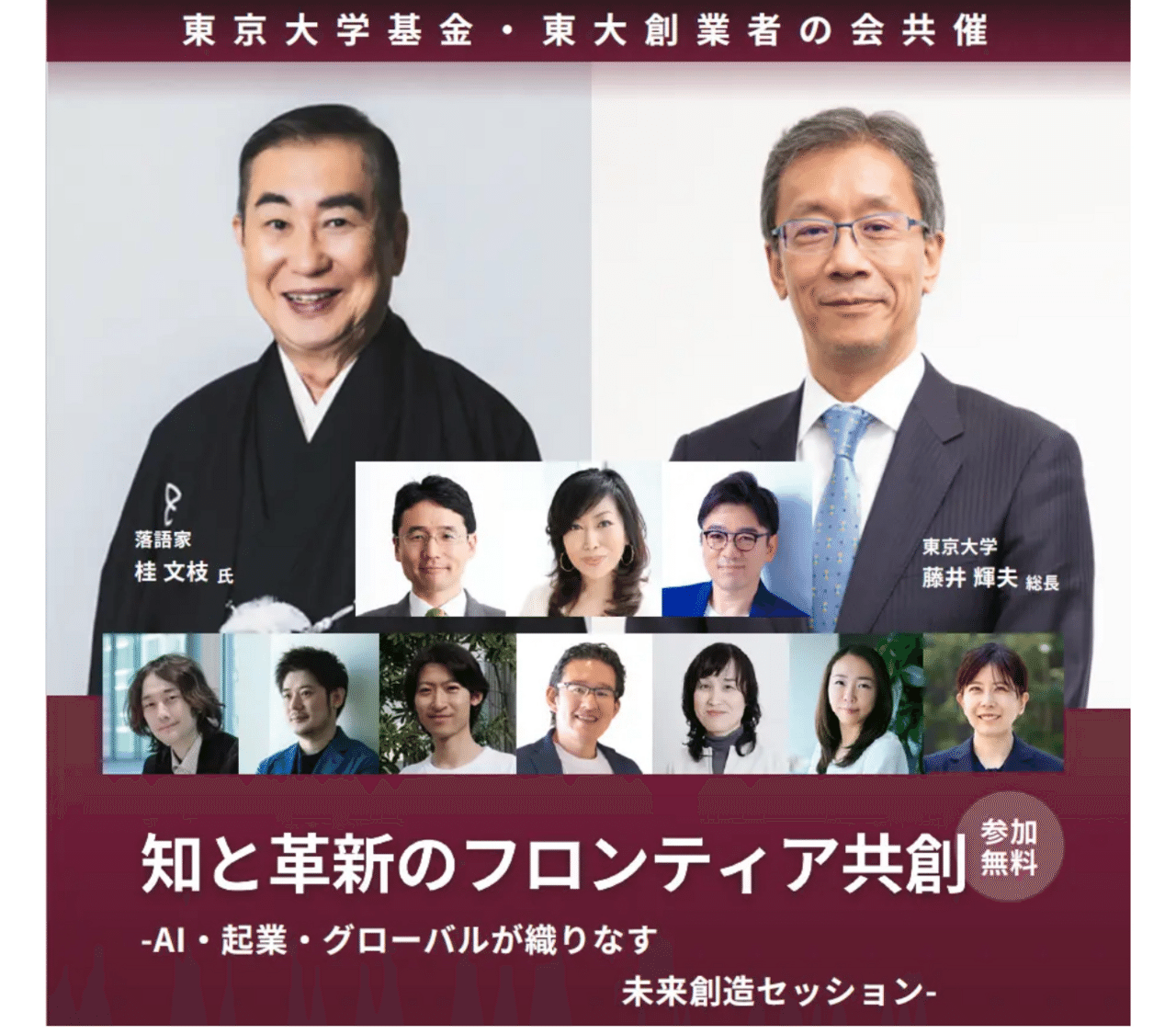
Noriko-san wrote about the experience on her note blog, describing the event as "興味深い一日" (a very interesting day). She noted how impressive the young entrepreneurs were, particularly those who had launched companies from abroad — something she deeply respects, having built her own career across two countries.
If you're not familiar with Noriko-san, she's worth knowing. Born in Yokohama, now based in Los Angeles, she runs NoriConnections — a platform dedicated to linking Japan and America. She's a certified Sake Navigator, the LA Branch Director of NPO ZESDA (Japan Economic System Design Association), and the author of a book on raising kids who get into America's top universities. She also serves as a miko (巫女) at events. A truly multi-talented person, and we're glad to call her a friend.
Seeing Eijiro-san present alongside other innovators at Todai — the university where he himself studied — seemed like a coming-of-age moment. The guy who graduated from there, spent 20 years in corporate Japan, opened a café in San Francisco, and then built a matcha machine that TIME Magazine put on its cover — now coming back to that same campus to share what he's learned with the next generation.
How We Met Eijiro-san: The M Cafe Story
So here's the part where this gets personal.
On February 21, 2026, Miki attended an event at M Cafe on La Brea in Los Angeles. The event was a reopening celebration featuring both Balmuda and Cuzen Matcha — and Miki was actually there because Balmuda had "secretly head-hunted" : ) her to help out at the event. (If you've been following us for a while, you know we love Balmuda!)
That's where we met Eijiro Tsukada in person for the first time.
She watched the Cuzen Matcha Maker in action, tasted freshly ground matcha made right there on the spot, and — I'll be honest — she fell in love with the machine.
We bought one that day.
That's the Cuzen Matcha box Miki is holding in the photo below with Eijiro-san!

Meeting Eijiro-san was really something. You could tell right away how passionate he is about matcha — not in a salesy way, but in a "this is my life's work" kind of way. When you know his background — Todai, Stanford, almost 20 years at Suntory, Stonemill, then building Cuzen from scratch — you understand that this machine represents everything he's learned. It all came together in one elegant product.
A quick word about M Cafe and its owner, Yuta Tsunoda, because his story deserves a mention too.
Yuta-san comes from one of the most storied restaurant families in Japan. His family's roots stretch back over 390 years to the original Hikage Chaya (日影茶屋) — a roadside tea house in Hayama, Japan. Let that number sink in for a moment. Three hundred and ninety years. What started as a resting spot for travelers eventually evolved into Michelin-rated kaiseki dining.
Yuta-san trained at the Four Seasons Hotel Los Angeles at Beverly Hills, then joined his family's business in 1993, eventually becoming CEO of the Chaya Restaurant Group. If you've been in LA long enough, you probably know Chaya Brasserie — they're famous for creating the tuna tartare back in 1984. That's not a dish they put on the menu. They invented it.
In 2005, Yuta-san founded M Cafe on Melrose Avenue, bringing modern macrobiotic cuisine to Los Angeles long before "clean eating" became a thing. The "M" stands for macrobiotic. Today, the La Brea location at 148 S La Brea Ave continues the tradition — Japanese-inspired, health-conscious, and genuinely delicious.
The fact that M Cafe chose to host both Cuzen Matcha and Balmuda at their reopening event tells you something about the caliber of these brands. These are all people who care deeply about quality and craft.

It was a really special afternoon. And truthfully, it was that day — meeting Eijiro-san, tasting what the machine could do, and watching people's faces when they tried freshly ground matcha for the first time — that planted the seed for us to become an authorized retailer.
If you are in the area, we strongly suggest stopping by M-Cafe. M-Cafe's food is just amazing and uses Cuzen Matcha Pro to try out the freshly ground matcha, and if you wish, you can purchase the machine right there.
M Cafe La Brea
148 S La Brea Ave,
Los Angeles, CA 90036
www.mcafedechaya.com
We Are Now an Authorized Retailer of Cuzen Matcha!
And this brings us back to the announcement we started with.
Japanese Green Tea Co. is now an authorized retailer of Cuzen Matcha.
We've been watching Cuzen for a while, and truthfully, we've been fans of Eijiro-san's approach from the beginning. His devotion to freshness, to organic farming, to supporting Japanese tea farmers, to design — it all matches what we believe in at Japanese Green Tea Co.
We are honored to carry this product, and we think it's a perfect fit for our community.
Click here to purchase Cuzen Matcha here
If you have any questions about the Cuzen Matcha Maker or want help choosing the right kit, please don't be reluctant to reach out to us.
We're here to help!
Conclusion
The Cuzen Matcha Maker is one of those rare products where you can feel the story behind it. It's not just a machine — it's the result of one person's 20+ year expedition through the tea industry, across two countries, through corporate success and startup struggle, all leading to a single question:
how do you make freshly ground matcha accessible to everyone?
Eijiro Tsukada found the answer. Honestly? It's pretty brilliant.
We're proud to carry Cuzen Matcha at Japanese Green Tea Co., and we hope you'll give it a try.
Thank you for reading!
Quick Reference: Cuzen Matcha at a Glance
| Detail | Matcha Maker (Home) | Matcha Maker Pro (Commercial) |
|---|---|---|
| Price | ~$299 (Starter Kit) | Contact Cuzen for pricing |
| Size | 13.4" H × 8.7" W × 4.7" D | Contact Cuzen for specs |
| Weight | 4.6 lbs | N/A |
| Mill Type | Single ceramic mill | Dual ceramic mills |
| Strength Levels | 3 | 7 |
| Speed | 2–4 min per shot | 2 shots in 40 seconds |
| Grind-Only Mode | Yes | Yes |
| Cost Per Shot | ~$0.85–$1.50 | N/A |
| Colors | White, Sumi Black | Contact Cuzen |
| Warranty | 1 year (US only) | Contact Cuzen |
| Voltage | 100–240V (universal) | Contact Cuzen |
| Particle Size | ~20 microns average | ~20 microns average |
| About Eijiro Tsukada | Details |
|---|---|
| Full Name | Eijiro Tsukada (塚田英次郎) |
| Title | Founder & CEO, Cuzen Matcha (World Matcha Inc.) |
| Education | University of Tokyo; Stanford GSB (MBA, 2004–2006) |
| Previous Career | ~20 years at Suntory (Brand Manager, Category Manager, GM of New Business Development) |
| Notable Achievement at Suntory | Led launch of Iyemon Toku-cha (10M+ cases in 11 months) |
| Previous Venture | Stonemill Matcha Café (San Francisco, 2018) |
| Co-founder | Oki Hatta (family roots in Yame, Fukuoka) |
| Company Founded | January 23, 2019 |
| HQ | San Mateo, CA (+ Meguro, Tokyo) |
| Contact | hi@cuzenmatcha.com |
| Website | cuzenmatcha.com |
FAQs about the Cuzen Matcha Maker
What is the Cuzen Matcha Maker?

Can I use any tea leaves with the Cuzen Matcha Maker?
 Matcha - Japanese Limited Reserve Ceremonial Green Tea - (Global Tea Champion 2018, 2025)
From $250.00 USD
USD
/
Matcha - Japanese Limited Reserve Ceremonial Green Tea - (Global Tea Champion 2018, 2025)
From $250.00 USD
USD
/
Is the Cuzen Matcha Maker worth the price?
Related products
7 reviews
$143.00 USD
$128.00 USD
USD
/
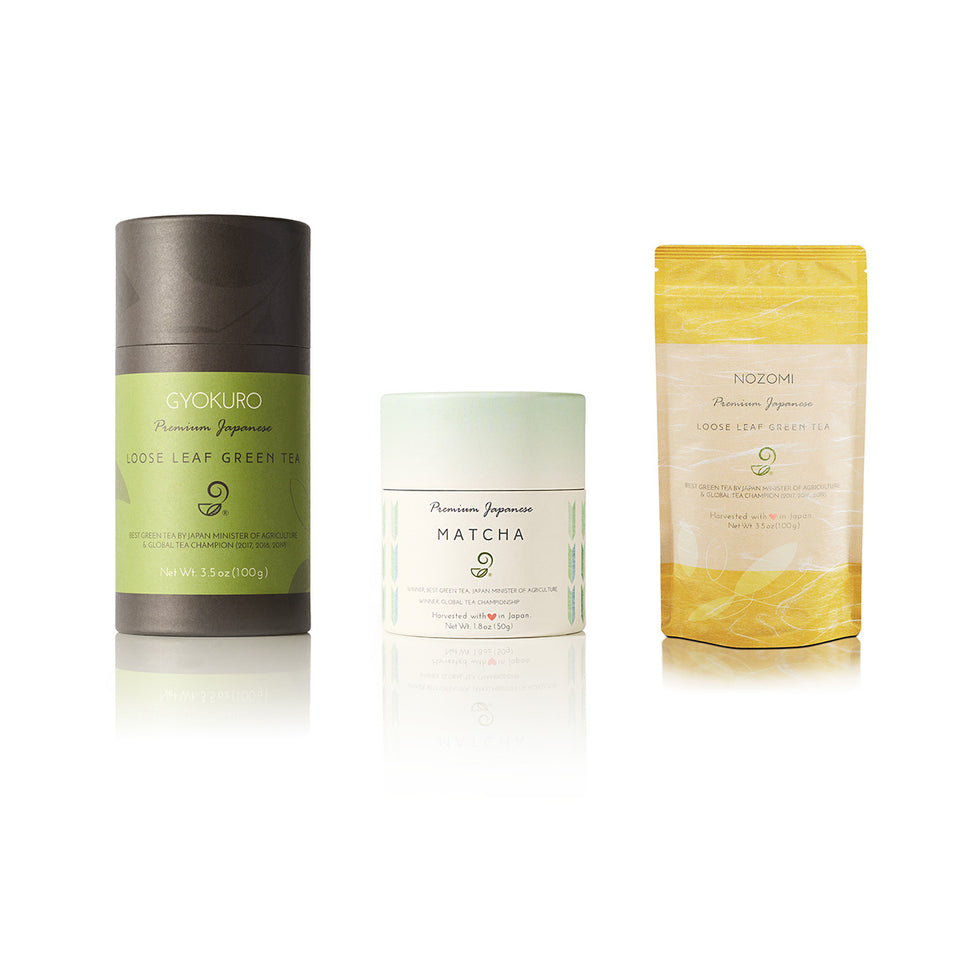
The Covered Trio Gift Set - Ceremonial Matcha, Gyokuro, and Nozomi Japanese Green Tea Set Package



Get Free Bonus Books

Sign up for free to the Green Tea Club to get advice and exclusive articles about how to choose Japanese Tea, and tips, tricks, and recipes for enjoying Japanese tea.
About the author
Kei Nishida
Author, CEO Dream of Japan
Certification: PMP, BS in Computer Science
Education: Western Washington University


