Table of contents
Introduction
We have a happy announcement to make!
We are excited to share that we have been a proud official retailer of BALMUDA — and to celebrate, BALMUDA has set up a limited-time offer just for our readers. (Details near the end of this article!)
And the product?
The famous BALMUDA fan is finally available in the USA.

If you've spent time in Japan, you've seen this fan.
It descends from the "GreenFan" — the Japanese fan that changed what people expect a fan to feel like when it launched back in 2010.
For the US market, BALMUDA calls it the NatureWind Studio.
But I don't want this to be just a product announcement, because the story behind this fan is one of my favorite business stories from Japan.
It has a rock musician who taught himself manufacturing, a company months away from collapse, and a fan that saved everything.
Let me tell you all about it!
Unboxing the NatureWind Studio
Before we get into the story, here is my unboxing video — this is everything that comes in the box, laid out exactly as it arrived:
The box itself is very BALMUDA: plain cardboard, no product photos, no marketing copy — just "NatureWind Studio, Designed by BALMUDA" printed down the side.
Even the spec panel on the side is printed as a simple line drawing of the fan — no glossy photo anywhere.

Then you open the lid, and there's a small surprise. Printed on the inside of the flap, where you only see it at the moment of opening, is one line:

"The breeze and tranquility of nature, bringing comfort to everyday living."
I stopped for a second when I saw it. It's a fan. It comes in a cardboard box. And somebody at BALMUDA decided the opening of that box should say something.
That's the company you're dealing with.
As you can see in the video, the fan arrives in pieces — the head, the tripod legs, the guard — each packed separately.
The one in my video is the black model (AGR01US-BK); it also comes in white.
More on why the airflow feels the way it does later in this article — there is real engineering behind it.
But first, let me tell you about the man who made it, because his story is worth your time.
What Is the NatureWind Studio?
Let me introduce the product properly.
The NatureWind Studio is BALMUDA's premium fan and air circulator, launched in the US on June 5, 2026.
It's made in Japan, and it comes in black or white.
As an official BALMUDA retailer, this is the product we've been most excited to bring to your attention this summer.
Now, a little naming history, because it matters.
In 2010, BALMUDA released a fan in Japan called the GreenFan — the fan that changed what people expect a fan to feel like.
It became famous, and BALMUDA's dual-blade fans have shipped nearly one million units worldwide since.
The fan arriving in America is the newest evolution of that line.
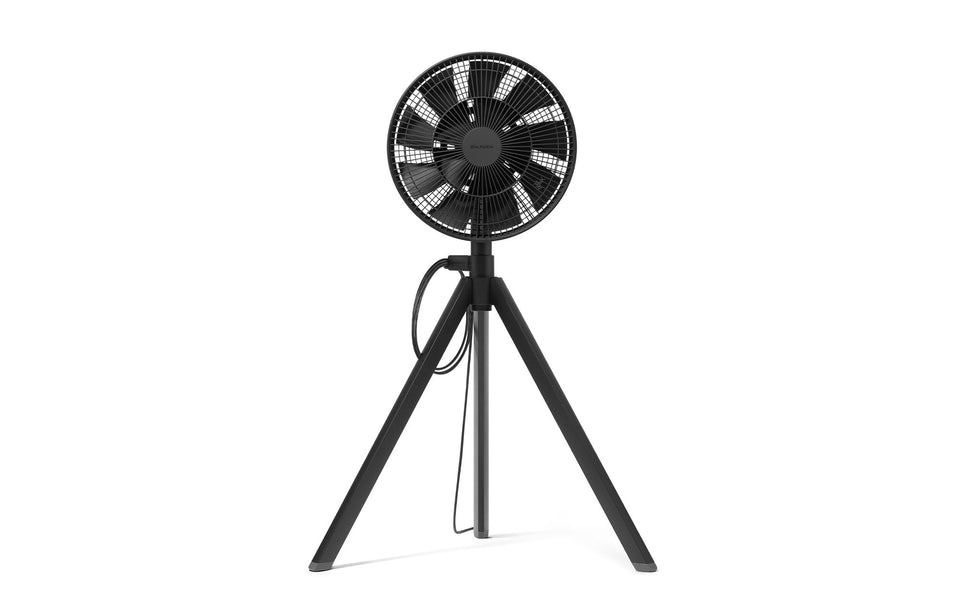
In Japan, it's sold as the GreenFan Studio — same dual-blade technology, redesigned as an all-season fan and circulator on slim metal tripod legs, like a piece of photography equipment.
For the US market, BALMUDA renamed it the NatureWind Studio—same fan, clearer name: natural wind, studio design.

Even the hub changes: Japan’s reads GreenFan, the US model reads BALMUDA, Designed in Tokyo.
A quick visual note, because photos from Japan can be confusing. BALMUDA sells many different fans there. But two fans stand out.
The one you've probably seen in Japanese homes is the classic GreenFan — the graceful single-pole pedestal fan, whose center pole can even be shortened to turn it into a desk fan.

The other is the GreenFan Studio: metal tripod legs, styled after studio equipment, planted wide and low.
That second one is the fan we get. Same model, same tripod — a different name on the box for America, and a fan guard reworked to meet US safety rules.
Only the Studio is officially sold in the US (for now), but it helps to know what separates the two models.
The classic GreenFan comes with a remote, offers an optional battery dock for cordless use, and can be set at two heights.
The Studio has none of that — no remote, no battery, one fixed height of about 35.5 in (90 cm), roughly windowsill level. It's a plug-in fan, full stop.
What the Studio gives you instead is the tripod design, a stronger Jet Mode for full-room circulation, and a light body — about 9 lbs (4.1 kg) — with a long 9.8 ft (3 m) cord, so moving it from room to room is a one-hand job as long as an outlet is in reach.
The US model isn't a straight copy of the Japanese one, either. American safety standards are stricter here, so the fan guard was redesigned to clear them: the gaps between the spokes are narrower, the guard itself is thicker, and it is screw-fastened, which the Japanese version doesn't do. Add the NatureWind Studio name, an AC adapter made for American outlets, and a US-only warranty, and that is what separates the two.

The guard on the US model: narrower gaps between the spokes, thicker, and screw-fastened. Photos courtesy of BALMUDA.
So why did it take sixteen years for BALMUDA's famous fan to cross the Pacific?
I asked, and the answer I was given makes sense:
BALMUDA wanted America to know them as a kitchen brand first. The Toaster, the Kettle, the coffee Brew — those built the name here.
Only now, with the brand established, are they bringing over the product that started everything in Japan.
Which brings us to the story of how it started — because the fan you just watched me unbox descends directly from a product that was developed in three months by a company on the edge of collapse.
Who Is Gen Terao (寺尾玄)?
Every BALMUDA product makes more sense once you know who founded the company, because Gen Terao (寺尾玄) did not take the normal route to appliance making. Or any normal route at all.
In 1990, at seventeen, he dropped out of high school. Then he left Japan and spent about a year wandering the Mediterranean — Spain, Italy, Morocco — carrying almost nothing.
From what I've read, that year gave him a conviction he still talks about: To live with very little, you need the best tools.
Back in Japan, he chased a different dream entirely. He spent nearly ten years as the singer and guitarist of a rock band. He gave it everything.
The band broke up in 2001, and at thirty, he was starting over.
Here's the part I love.
Instead of finding a safe job, he decided he still wanted to make things people love — just not with a guitar.
He has said in interviews that the companies he admired, like Apple and Patagonia, looked like rock bands to him:
They made things because they wanted to, not because a survey told them to.
So he taught himself manufacturing from zero knowledge.
He walked around Akihabara's (秋葉原) electronics district asking shopkeepers about materials, absorbing technical vocabulary one term at a time.
He knocked on the doors of small machining factories around Tokyo and asked the operators to teach him.
What a rockstar move! I love this story so much.
In 2003, he founded BALMUDA Design — a one-person company run from his own room. His first product was an aluminum laptop stand he milled and assembled by hand.
If you read Japanese, Terao-san wrote a book about all of this — Ikō, Doko ni mo Nakatta Hōhō de (行こう、どこにもなかった方法で — roughly translated, "Let's Go, in a Way No One Has Tried Before") — and it's worth your time.

You can find it here. It hasn't been translated into English yet, which honestly feels like a missed opportunity for some publisher.
A high school dropout, a failed musician, a self-taught craftsman.
By 2009, his little company was making beautiful lamps and accessories — and it was about to die.
That's where the fan comes in.
The Fan That Saved BALMUDA
By 2009, BALMUDA was in serious trouble.
The company had three employees. According to BALMUDA's own account, revenue was around ¥45 million (about $300,000), the year closed ¥14 million in the red, and they were carrying ¥30 million in debt.
The 2008 global recession had crushed demand for beautiful, expensive desk lamps.
Terao-san was staring at his second collapsed dream — first the band, now this. His response, in his own words from BALMUDA's company story:
"I refuse to go under."
He had been quietly carrying an idea for a completely different kind of product — a fan that wouldn't feel like a fan.
In a conversation published on BALMUDA's site, Terao-san described that period as thinking about the fan all day, every day, for a year.

Idea sketches for the fan
When the company hit the wall, he bet everything on it.
Taking the GreenFan from concept to mass production in three months, then somehow raised ¥60 million in funding when the company looked unfundable.
Selling it was another battle.
An unknown three-person company asking ¥35,000 (about $230 at the time) for a fan, when a regular fan cost a tenth of that — every major retail buyer said no at first.
But once people actually felt the GreenFan's breeze, word spread, and it broke through.
The GreenFan became one of the defining Japanese appliances of the decade.
And it turned BALMUDA from a company on the edge of collapse into a household name.
Everything that followed — the Toaster, the Kettle, the Clock — exists because this one fan worked.
So when I say this is the fan that saved BALMUDA, I mean it literally—no GreenFan, and BALMUDA might never have made it to America. And now it's here.

Why It Doesn't Feel Like a Fan
Now let me explain what makes this fan different, because "it feels like natural wind" sounds like marketing until you understand the mechanism.
Think about why regular fan air feels bad.
A normal fan blade chops the air and throws it at you as a spinning vortex — a tight, drilling column of wind. Your skin notices.
It's the difference between a breeze and being blown on. Nobody sits in front of a regular fan for an hour by choice.
Terao-san's insight was that the vortex itself is the problem. His solution: two sets of blades on one head.

The inner blades push air slowly. The outer blades push air fast.
When the two airflows meet, the speed difference cancels out the vortex — and instead of a drilling column, the air spreads into a wide, flat sheet that moves through the room the way wind moves through an open window.
BALMUDA says the spread is about four times wider than a typical fan's.
That's the whole trick. Not more power, not more features — just air that arrives the way outdoor air arrives.
Behind the blades sits a brushless DC motor that can turn precisely at very low speeds, which is what makes the gentlest settings possible at all.
On its lowest setting, the fan draws just 1.5 W — less power than a nightlight.
The technology has a name in Japan — GreenFan technology — and BALMUDA has been refining it since 2010.
Sixteen years of iteration on one idea: air should feel like air.
Quieter Than Leaves
Here's my favorite piece of trivia about this fan.
On its lowest setting, the NatureWind Studio operates at 9 decibels. For context: rustling leaves measure around 20 dB. A human whisper is about 30 dB.
This fan, running, is quieter than the sound of leaves in a light wind.
In a silent room at night, you will hear the air moving before you hear the machine moving it.
That matters more than it sounds like it should. A fan you can hear is a fan you eventually turn off — in the bedroom, during a call, while you're reading.
A fan you can't hear stays on, doing its job.

And when you need the opposite of quiet, there's Jet Mode — the strongest of the five speed settings, pushing air up to 75 feet (about 23 m). That's not for sitting in front of.
It's for circulation: moving cooled air from the room with the AC vent to the room without one, drying out a humid closet, pulling fresh air through the house with the windows open.
This is why BALMUDA calls it a fan and an air circulator — it genuinely works year-round, not just in August.
Five speeds, from below-a-whisper to across-the-house.
Most fans give you three versions of the same unpleasant blast.
How to Use It: Speeds, Placement, and a Few Tricks
Let's get practical.
A fan engineered like this rewards a little thought about where you put it and which speed you pick.
Speeds 1–2 are the natural breeze zone.
This is where the dual-blade magic happens — air that drifts rather than blows.
Use these for sleeping, desk work, or anywhere you'll sit for hours. At 9 dB, speed 1 is quiet enough for a nursery or the lightest sleeper in your house.
Because it uses just 1.5 watts on low, you can run it all night, every night, for a month, and the electricity adds up to less than a dime.
Speeds 3–4 are for hot afternoons and bigger spaces — still smooth, just more volume.
Jet Mode is a different tool entirely.
Don't sit directly in front of it. Point it where you want air to go.
That's the answer to a fair question: does a gentle Japanese fan make sense in a big, open-plan American home? It does, because of its reach.
On Jet Mode, it works as a high-velocity air circulator, pushing air up to 75 feet (about 23 m).

A few tricks:
The AC Boost: Put the fan under an AC vent on Jet Mode, aiming toward an adjacent, warmer room.
It breaks up the warm air layers that trap themselves against high ceilings, evening out the temperature so you can raise your thermostat a degree or two without noticing.
The Movie Night Trick: A regular fan competes with whatever you are watching, and you end up riding the volume button all evening.
Speeds 1 and 2 are quiet enough that you can put the NatureWind Studio right next to the couch or the media console without touching your audio setup.
The Window Pull: On a cool evening, set it near an open window on Jet Mode facing into the room.
It pulls crisp outdoor air through the house, flushing out a home that's been sealed up all day in under ten minutes.
The oscillation range is adjustable up to 150°, and this is nicer than it sounds: set it narrow for a personal breeze that stays on you, or wide to let air drift across the whole room.
One more practical note — cleaning is painless.

The fan guard comes apart without tools, and the parts rinse clean under a faucet.
Anyone who has ever scrubbed grey dust out of a metal grille with a toothbrush knows why this matters.

Analog on Purpose
Here's something that will either annoy you or delight you, and I think which one says a lot about the moment we're living in.
The NatureWind Studio has no remote control. No Wi-Fi. No app. No screen.
You walk over to the fan and press a button on the body — and that's the entire interface.
This is not a missing feature. It's a decision.
In Japan, where this fan sells as the GreenFan Studio, some reviewers grumble about the missing remote — and BALMUDA has held the line anyway.
In an era when your toothbrush wants a firmware update, BALMUDA built a fan that will never ask you to create an account.
If you read our article about BALMUDA The Clock, you'll recognize the philosophy.
The Clock is the same idea: a beautiful object that does one thing, controlled by physical switches, with nothing to sync and nothing to charge.
BALMUDA keeps making this choice on purpose, product after product.
There's a practical upside too.
No app means nothing to break, no server to shut down in five years, no reason this fan won't work the same way in 2040. You press the button; the wind comes out. That's the deal.
I find it calming, honestly.
The fan is called NatureWind — and something is fitting about the controls being as simple as the breeze.
A Harsher Summer, a Natural Breeze
Let me tell you why this fan matters to me right now, in 2026.
The summers are not what they used to be. Los Angeles, where I live, keeps setting records.
Japan keeps setting records.
Everywhere keeps setting records.
And our answer, mostly, is to seal the windows and run the AC harder — which works, but leaves the house feeling stale, with cold spots in one room and dead air in the next.
Here's what I found interesting: BALMUDA says the same thing.
On their Japanese page for this fan, they write that in the fifteen years since the original GreenFan, the atmosphere and the summer heat have grown more intense — and this fan is their answer to that.
It circulates the cooled air your AC already made, reaches the rooms the vents don't, and on gentle days, pulls real outdoor air through the house so you can give the AC a rest.
My hope is simple.
I hope this fan brings a little bit of natural breeze back into your summer — the kind of air you remember from before summers got like this.
That's worth something. Maybe more than ever.
How to Get the Limited-Time Offer
Now, the part I promised at the top.
As an official BALMUDA retailer, we arranged something for our readers: a 15% discount code for BALMUDA's US online store, valid for a limited time.
Sign up for the Green Tea Club Newsletter for free (unsubscribe any time) to get the code. Drop your email address here, and you will get the code right away:
Get My 15% BALMUDA Code
Once you have the code, you can use it on the NatureWind Studio — or on anything else at BALMUDA's US store, if the Toaster has been calling your name.
Conclusion
Sixteen years ago, a self-taught craftsman bet a dying company on the idea that a fan should feel like wind, not a machine.
That bet saved BALMUDA.
It built everything that came after — the Toaster, the Kettle, the Clock.
And this summer, the fan itself has finally arrived in America, with a new name and the same idea inside.
I'm glad it's here. I think you will be too.
Stay cool out there — naturally.
Quick Reference: NatureWind Studio at a Glance
| Also known as | GreenFan Studio (Japan) — evolution of the 2010 GreenFan |
| Type | Fan + air circulator (indoor, household) |
| US launch | June 5, 2026 |
| Model | AGR01US-BK (Black) / AGR01US-WH (White) |
| Dimensions | Approx. 23.6 in (W) × 20.5 in (D) × 35.5 in (H) — approx. 90 cm tall |
| Weight | Approx. 9 lbs (4.1 kg) |
| Speeds | 5, including Jet Mode |
| Noise level | 9 dB on the lowest setting (US spec) |
| Airflow reach | Up to 75 ft (approx. 23 m) |
| Power | 24 V adapter; 1.5 W min – 36 W max |
| Cord | Approx. 9.8 ft (3 m), integrated |
| Controls | On-body buttons only — no remote, no app |
| Cordless? | No — plug-in only |
| Made in | Japan |
| Warranty | US-only |
| Where to buy | BALMUDA US online store (15% code for our readers — see above) |
Related products


Get Free Bonus Books

Sign up for free to the Green Tea Club to get advice and exclusive articles about how to choose Japanese Tea, and tips, tricks, and recipes for enjoying Japanese tea.
About the author

Kei Nishida
Author, CEO Dream of Japan
Certification: PMP, BS in Computer Science
Education: Western Washington University